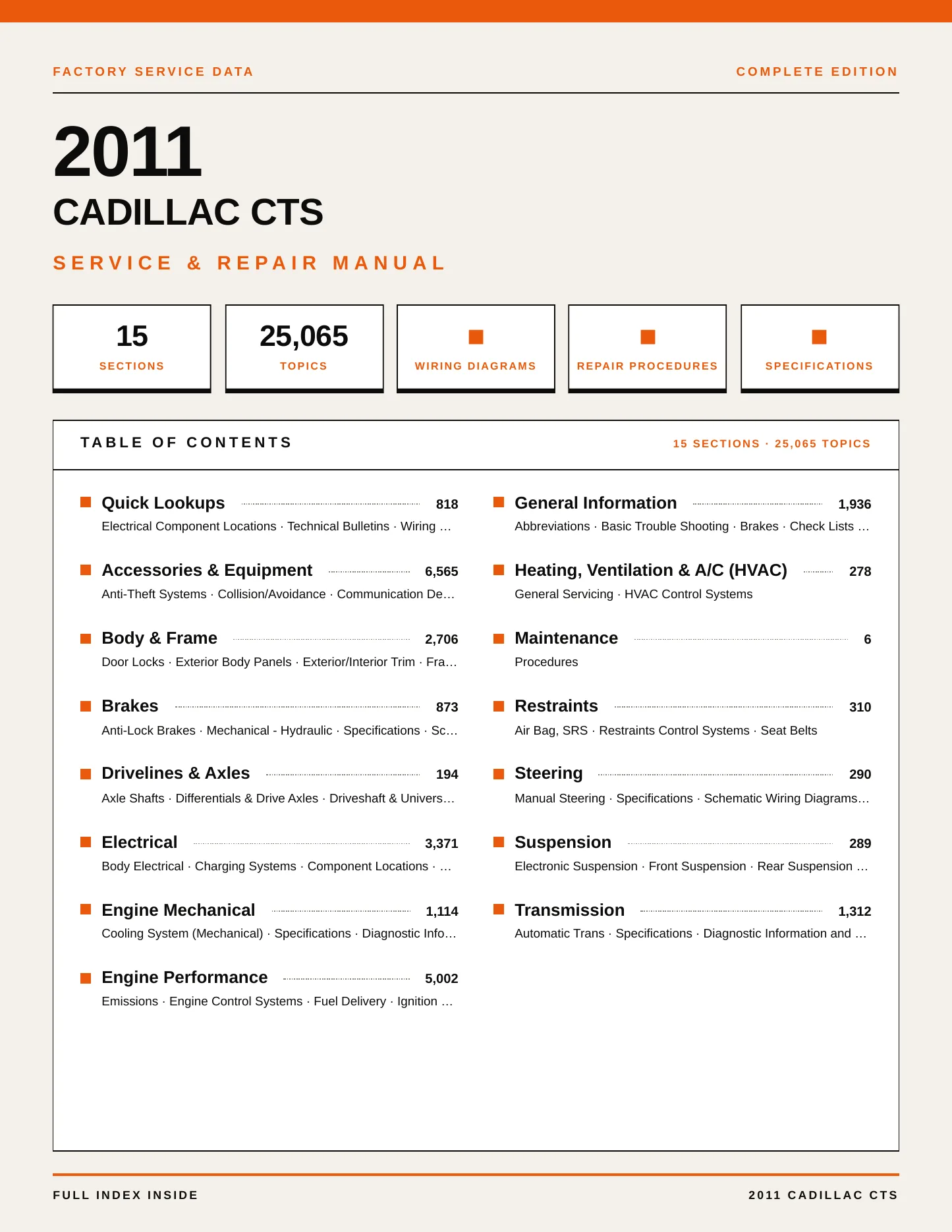
2011 Cadillac CTS Service and Repair Manual
The 2011 Cadillac CTS was offered with a choice of three engines, and this factory service and repair manual gives you the OEM procedures and specifications tied to your specific engine and trim instead of a generic writeup.
Engines covered
- 3.0L V6 (182 cu in) — DOHC, naturally aspirated, gasoline
- 3.6L V6 (217 cu in) — DOHC, naturally aspirated, gasoline
- 6.2L V8 (376 cu in) — OHV, supercharged, gasoline
Body styles covered
- 4-door wagon
- 4-door sedan
- 2-door coupe
Trims covered
- Base
- Coupe
- Luxury
- Performance
- Premium
- V
Known issues on the 2011 CTS. Two recalls are on federal record for this model year. The first covers the roof rail air bags: drive shaft vibration can cause the vehicle's roll over sensor to command an unexpected deployment, raising the risk of a crash and occupant injury. The second covers the ignition: weight on the key ring can pull the key out of the run position, and if the vehicle is then involved in a crash the air bags may not deploy, increasing the risk of injury. Owners have filed 108 complaints for the year. The factory diagnostic and repair procedures behind each of those systems are here.
Whether you're tracing an air bag deployment fault, checking the ignition switch, or servicing the supercharged V8, it keeps you on the OEM procedure and the correct specification for your specific 2011 CTS.
General Motors LLC (GM) is recalling certain model year 2011 Cadillac CTS vehicles manufactured October 18, 2010, to June 2, 2011. In the affected vehicles, vibrations from the drive shaft may cause
If the roof rail air bags deploy unexpectedly, there is an increased risk of crash and injury to the
GM will notify owners, and dealers will replace the rear drive shaft assembly, free of charge. Gene
This defect can affect the safe operation of the airbag system. Until this recall is performed, customers should remove all items from their key rings, leaving only the ignition key. The key fob (if
If the key is not in the run position, the air bags may not deploy if the vehicle is involved in a c
GM will notify owners, and dealers will install two key rings and an insert in the key slot or a cov
This preliminary information communicates information about how to determine if a wheel and tires size change is available.
This Preliminary information communicates the steps on how to save a GDS2 Session Log and upload to a Technical Assistance Case in CX Connect.
This preliminary information advises a dealer on how to email GDS2 session logs into Technical Assistance.
This service bulletin provides information on Tire Sidewall Irregularities.
This service bulletin provides information on replacing the intake manifold when the engine is replaced after severe internal engine damage.
This Preliminary Information communication provides information to the technician about vehicles that have had multiple repair attempts that are being performed on customers vehicles that exhibit vibration conditions without utilizing the s
The service bulletin advises the tech of a normal transmission shift condition and the delay in throttle response when the throttle plate is opened rapidly and advises the customer that it is normal for the delay.
Showing the 8 most recent of 586 technical service bulletins on file with NHTSA.
ON 12-2-19 AT 730AM EASTERN TIME, I WAS INVOLVED IN A 55 MPH SIDE IMPACT CRASH TO THE RIGHT SIDE OF THE VEHICLE BY A SEMI TRUCK ON INTERSTATE 475 NORTH IN TOLEDO, OHIO, MILE MARKER 10, NEAR HOLLAND, O
TL* THE CONTACT OWNS A 2011 CADILLAC CTS. WHILE DRIVING APPROXIMATELY 25 TO 30 MPH, THE CONTACT LOST CONTROL OF THE VEHICLE AND CRASHED INTO A POST. THE AIR BAGS FAILED TO DEPLOY. THE CONTACT WAS INJU
TL* THE CONTACT OWNS A 2011 CADILLAC CTS. THE CONTACT STATED THAT WHILE DRIVING, THE ENGINE SEIZED AND THE BRAKES FAILED. AS A RESULT THE CAR CRASHED INTO AN EMBANKMENT. THE CONTACT SUSTAINED HEAD AND
The contact owns a 2011 Cadillac CTS. The contact stated that while driving approximately 30 -35 mph, there was a rattling noise detected from the front end of the vehicle. The brake pedal was applied
WHILE DRIVING ON A WINDY MOUNTAIN ROAD AT APPROX 45 MPH, GOING INTO A SHARP LEFT HAND TURN, THE STEERING WHEEL WOULD NOT TURN ANY FURTHER. IT FELT AS THOUGH THE STEERING HAD GONE OUT COMPLETELY. THIS
Showing the 5 most serious of 148 complaints filed with NHTSA.