
Be the first to write a review
0%
(0)
0%
(0)
0%
(0)
0%
(0)
0%
(0)
Labor Day Sale: 30% off · Code LABOR30


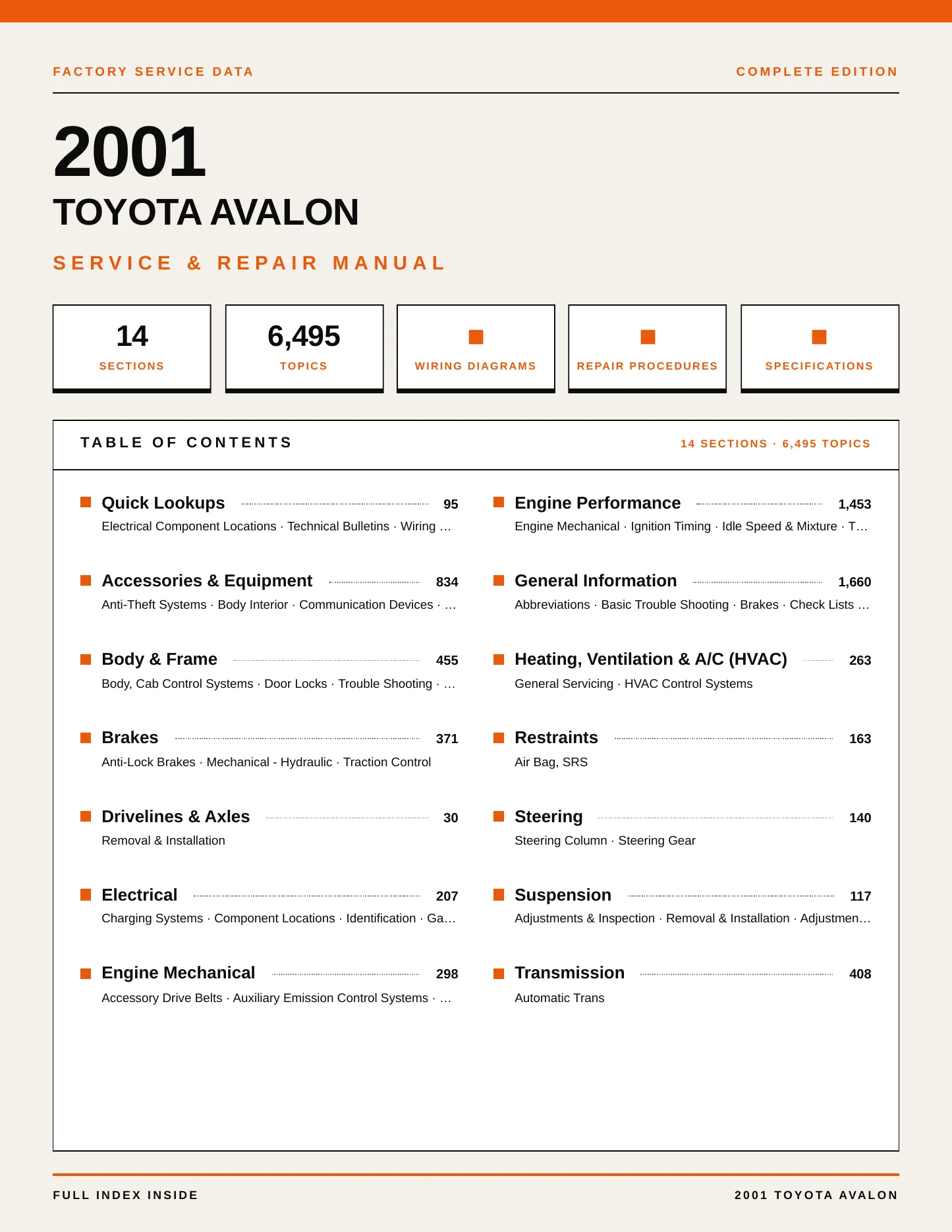
2001 Toyota Avalon Service and Repair Manual

Written for the 2001 Toyota Avalon exactly as Toyota built it that year, this factory service and repair manual works from the car in front of you: the 3.0L V6 (1MZ-FE) under the hood and the XL or XLS trim you are working on, so the figures you work to are the ones Toyota published for this model year rather than numbers carried over from an adjacent one.
Engines
Trims
Known issues on the 2001 Avalon. One recall is on federal record for this model year, and it concerns the steering. Toyota recalled certain model year 2000-2004 Avalon vehicles because improper casting of the steering lock bar creates the possibility that a minute crack may develop on its surface; should the steering lock bar break, the steering wheel would lock. Owners have filed 168 complaints against the 2001 Avalon, and Toyota has issued 81 technical service bulletins for it.
Knowing that history before you start changes how you approach the job, whether you are chasing a steering column fault, working through the V6's service intervals, or checking whether one of those 81 bulletins applies to the repair in front of you.
TOYOTA IS RECALLING CERTAIN MODEL YEAR 2000-2004 AVALON VEHICLES. DUE TO IMPROPER CASTING OF THE STEERING LOCK BAR, THERE IS A POSSIBILITY THAT A MIN
SHOULD THE STEERING LOCK BAR BREAK, THE STEERING WHEEL WOULD LOCK AND THE DRIVER WOULD LOSE THE ABILITY TO STEER THE VEH
DEALERS WILL REPLACE THE STEERING INTERLOCK DEVICE FREE OF CHARGE. THE SAFETY RECALL BEGAN ON SEPTEMBER 7, 2010. OWNER
VEHICLE DESCRIPTION: PASSENGER VEHICLES. THE FRONT SUB FRAME ASSEMBLY HAS NOT BEEN ADEQUATELY WELDED.
THIS CONDITION COULD CAUSE FAILURE OF THE ASSEMBLY FOLLOWING LONG-TERM USAGE, INCREASING THE RISK OF A CRASH.
DEALERS WILL INSPECT AND REPLACE THE FRONT SUB FRAME, IF NECESSARY. OWNER NOTIFICATION BEGAN APRIL 9, 2001. OWNERS WHO
The condition known as acid rain is caused by airborne chemicals or particles in the atmosphere, which mix with rainwater, nighttime dew, or high humidity to form acidic compounds. If these contaminants settle and remain on a painted vehicl
To prevent brake rotor rust from forming during transportation and storage, wheel film will be used instead of a cardboard type of anti-rust cover. The purpose of the wheel film is to shield the disc brake rotor from weather elements and in
Acid rain results from rainwater or other airborne moisture that become acidic due to industrial chemical impurities in the atmosphere. If these acidic compounds settle on an exposed vehicle, especially the horizontal areas such as the hood
Toyota vehicles are currently protected with RapgardTM protective film designed to protect the horizontal painted surfaces. This material protects from acid rain, environmental fallout, and rail contamination. Follow the Removal Procedure i
Vehicles may occasionally be subjected to contamination by airborne iron particles shed from railroad tracks, train wheels, exposure to heavy machinery facilities, grinding, welding, etc. This type of contamination can be identified by the
The condition known as acid rain is caused by airborne chemicals or particles in the atmosphere, which mix with rainwater, nighttime dew, or high humidity to form acidic compounds. If these contaminants settle and remain on a painted vehicl
To prevent brake rotor rust from forming during transportation and storage, wheel film will be used instead of a cardboard type of anti-rust cover. The purpose of the wheel film is to shield the disc brake rotor from weather elements and in
Acid rain results from rainwater or other airborne moisture that become acidic due to industrial chemical impurities in the atmosphere. If these acidic compounds settle on an exposed vehicle, especially the horizontal areas such as the hood
Showing the 8 most recent of 125 technical service bulletins on file with NHTSA.
TIRES TOO NARROW AND SMALL FOR GROSS WEIGHT OF AVALON CAR. (DOT NUMBER: 205 TIRESIZE: 205 60 R)
VEHICLE WAS AT STANDSTILL IN TRAFFIC AND WAS REARENDED. TRUNK WAS PUSHED INTO BACKSEAT. VEHICLE WAS PUSHED INTO VEHICLE
TL* THE CONTACT OWNED A 2001 TOYOTA AVALON. THE CONTACT STATED THAT WHILE HER BROTHER WAS STOPPED AT A SIGN, A VEHICLE C
WHILE DRIVING, THE VEHICLE SUDDENLY ACCELERATED, THE CONSUMER LOSS CONTROL OF THE VEHICLE AND HIT A PICKUP TRUCK AND CRA
WHILE DRIVING AT 35 MPH VEHICLE SUDDENLY ACCELERATED OUT OF CONTROL HIT A PICKUP TRUCK, AND THEN HIT A TREE. THE DRIVER
Showing the 5 most serious of 140 complaints filed with NHTSA.