
Be the first to write a review
0%
(0)
0%
(0)
0%
(0)
0%
(0)
0%
(0)
Labor Day Sale: 30% off · Code LABOR30


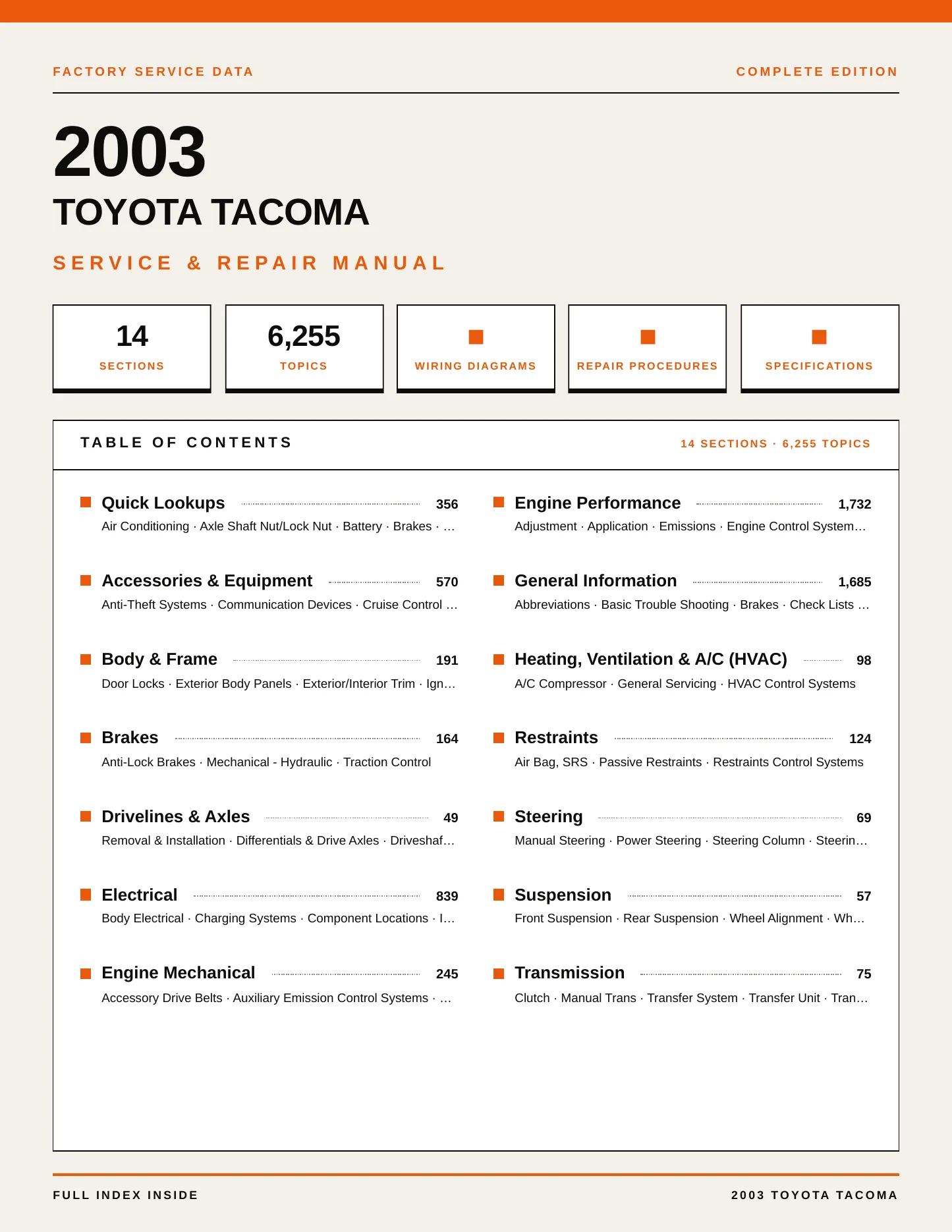
2003 Toyota Tacoma Service and Repair Manual

The 2003 Toyota Tacoma was offered with three engines: the 2.4L four (2RZ-FE), the 2.7L four (3RZ-FE) and the 3.4L V6 (5VZ-FE), across bodies that ran from the 2D Pickup and Extra Cab up to the 4D Pickup, and trims from Base through PreRunner to the S-Runner. Torque figures, clearances and service intervals on this truck change with that combination, so the engine and cab you are working on decide which numbers apply.
Engines
Trims
Known issues on the 2003 Tacoma. Two recalls sit on the federal record for this model year. The first covers the gasoline fuel delivery system, specifically the hoses, lines, piping and fittings: during a side impact NCAP test, a flange at the rear end of the double cab body deformed and interfered with the fuel inlet hose. That damage could result in fuel leakage, which could result in a fire. The second covers the front suspension lower control arm ball joint, where a manufacturing issue meant the surface of the ball of the joint may have been scratched; the lower ball joint may separate from the knuckle, causing loss of steering control. Beyond the recalls, the 2003 Tacoma carries 479 owner complaints and 76 technical service bulletins.
Whether the job is the fuel inlet hose at the rear of the cab, a front lower ball joint on a PreRunner or a scheduled service on the 3.4L V6, the specifications that matter are the ones Toyota published for the 2003 Tacoma rather than for a neighboring model year.
Toyota is recalling certain model year 2001 through 2004 Tacoma light trucks manufactured from August 28, 2000, through August 27, 2004, and originall
Corrosion of the plate could cause it to break, which could result in detachment of the spare tire from the vehicle. Det
Toyota will notify owners, dealers will inspect the vehicle and replace the spare tire carrier lift plate as necessary,
CERTAIN AJ MOTORSPORT COMBINATION LAMPS SOLD AS REPLACEMENT LAMPS FOR USE ON THE ABOVE LISTED PASSENGER VEHICLES. COMBINATION LAMPS NOT EQUIPPED WITH
LACK OF AMBER SIDE REFLECTORS IN THE LAMPS WILL DECREASE LIGHTING VISIBILITY TO OTHER DRIVERS AND MAY POSSIBLY RESULT IN
AJ MOTORSPORT WILL NOTIFY OWNERS AND OFFER REIMBURSEMENT FOR THE LAMPS. THE RECALL BEGAN ON JULY 31, 2006. OWNERS MAY
CERTAIN PRO-A MOTORS CORNER LAMPS, TURN SIGNALS, AND HEADLIGHTS SOLD AS REPLACEMENT LAMPS FOR USE ON CERTAIN PASSENGER VEHICLES LISTED ABOVE. SOME CO
WITHOUT THE AMBER REFLECTORS, THE VEHICLE WILL BE POORLY ILLUMINATED, POSSIBLY RESULTING IN A VEHICLE CRASH WITHOUT WARN
PRO-A MOTORS WILL NOTIFY OWNERS AND OFFER TO REPURCHASE THE LAMPS. THE RECALL BEGAN ON APRIL 3, 2006. OWNERS MAY CONTA
ON CERTAIN SPORT UTILITY VEHICLES, DUE TO A MANUFACTURING ISSUE IN THE FRONT SUSPENSION LOWER BALL JOINT, THERE IS A POSSIBILITY THAT THE SURFACE OF T
THE LOWER BALL JOINT MAY SEPARATE FROM THE KNUCKLE CAUSING LOSS OF STEERING CONTROL AND A CRASH COULD OCCUR.
DEALERS WILL REPLACE THE FRONT SUSPENSION LOWER BALL JOINTS FREE OF CHARGE. THE RECALL BEGAN ON JULY 5, 2005. OWNERS M
ON CERTAIN PICKUP TRUCKS, DURING SIDE IMPACT NCAP TEST (I.E. LINCAP TEST), A FLANGE AT THE REAR END OF THE DOUBLE CAB BODY DEFORMED AND INTERFERED WIT
THIS DAMAGE COULD RESULT IN FUEL LEAKAGE, WHICH COULD RESULT IN A FIRE IF IN THE PRESENCE OF AN IGNITION SOURCE.
DEALERS WILL INSTALL A FUEL HOSE PROTECTOR ON THE BODY FLANGE. OWNER NOTIFICATION BEGAN JUNE 3, 2003. OWNERS WHO TAKE
The condition known as acid rain is caused by airborne chemicals or particles in the atmosphere, which mix with rainwater, nighttime dew, or high humidity to form acidic compounds. If these contaminants settle and remain on a painted vehicl
To prevent brake rotor rust from forming during transportation and storage, wheel film will be used instead of a cardboard type of anti-rust cover. The purpose of the wheel film is to shield the disc brake rotor from weather elements and in
Acid rain results from rainwater or other airborne moisture that become acidic due to industrial chemical impurities in the atmosphere. If these acidic compounds settle on an exposed vehicle, especially the horizontal areas such as the hood
Toyota vehicles are currently protected with RapgardTM protective film designed to protect the horizontal painted surfaces. This material protects from acid rain, environmental fallout, and rail contamination. Follow the Removal Procedure i
Vehicles may occasionally be subjected to contamination by airborne iron particles shed from railroad tracks, train wheels, exposure to heavy machinery facilities, grinding, welding, etc. This type of contamination can be identified by the
The condition known as acid rain is caused by airborne chemicals or particles in the atmosphere, which mix with rainwater, nighttime dew, or high humidity to form acidic compounds. If these contaminants settle and remain on a painted vehicl
To prevent brake rotor rust from forming during transportation and storage, wheel film will be used instead of a cardboard type of anti-rust cover. The purpose of the wheel film is to shield the disc brake rotor from weather elements and in
Acid rain results from rainwater or other airborne moisture that become acidic due to industrial chemical impurities in the atmosphere. If these acidic compounds settle on an exposed vehicle, especially the horizontal areas such as the hood
Showing the 8 most recent of 139 technical service bulletins on file with NHTSA.
THE CONSUMER WAS INVOLVED IN AN ACCIDENT AND NONE OF THE AIR BAGS DEPLOYED. *JB
TL*THE CONTACT OWNS A 2003 TOYOTA TACOMA. WHILE DRIVING 25 MPH IN ICY CONDITIONS, THE VEHICLE CRASHED HEAD ON INTO A WI
Truck crashed into rocks on shoulder and rolled over. Driver side Windshield and roof crushed. Air bag did not deploy. S
TL* THE CONTACT OWNS A 2003 TOYOTA TACOMA. WHILE DRIVING APPROXIMATELY 20 TO 25 MPH AND EXITING A RAMP, THE REAR OF THE
TL*THE CONTACT OWNS A 2003 TOYOTA TACOMA. WHILE DRIVING 70 MPH, THE CONTACT FELL ASLEEP OR BLACKED OUT. THE VEHICLE HIT
Showing the 5 most serious of 371 complaints filed with NHTSA.