
Be the first to write a review
0%
(0)
0%
(0)
0%
(0)
0%
(0)
0%
(0)


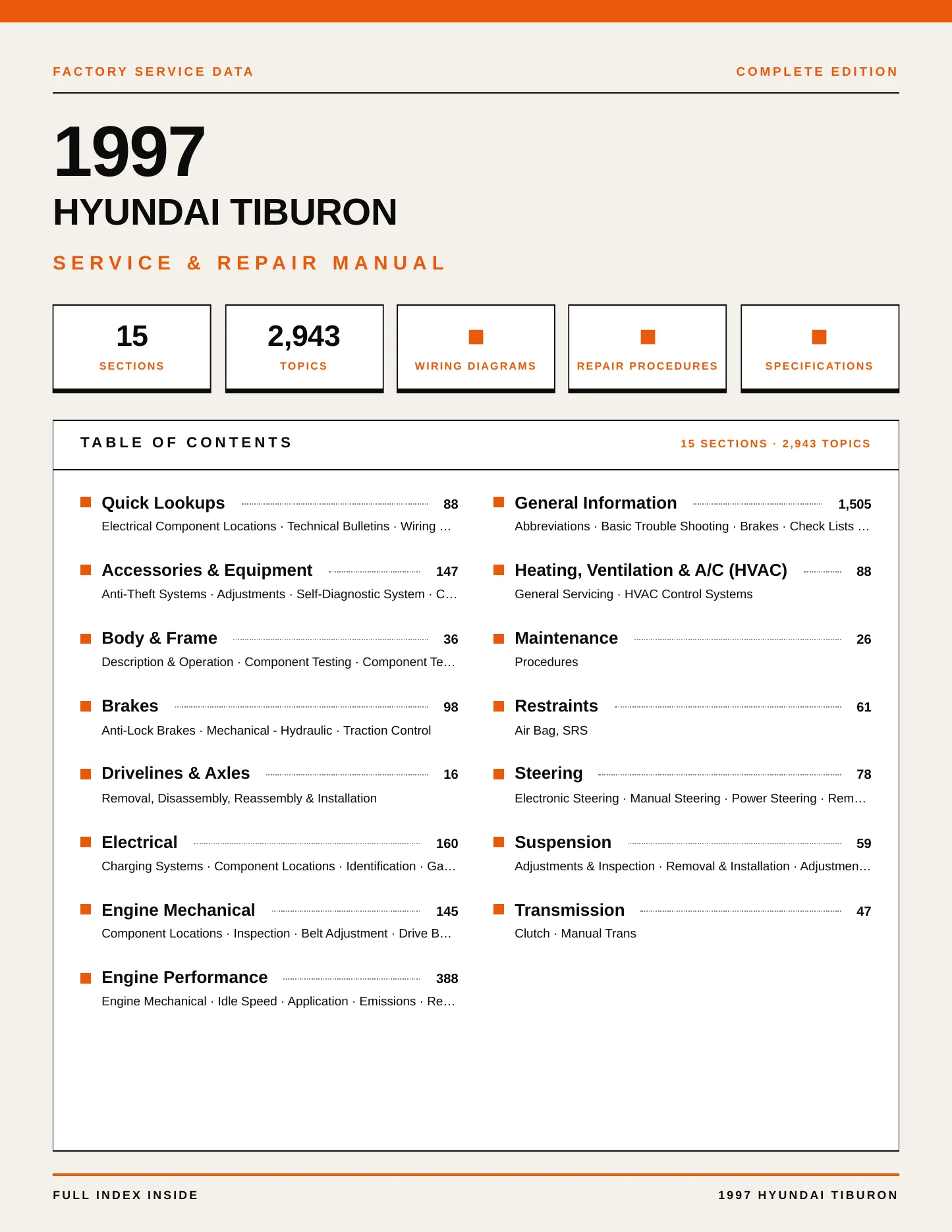
1997 Hyundai Tiburon Service and Repair Manual

1997 Hyundai Tiburon service and repair manual — a detailed, factory-style reference for maintenance, diagnostics, and repair. Use it to confirm correct procedures, specifications, and system coverage before you start work.
Designed for technicians and DIY owners, this manual helps you diagnose issues correctly, follow proven repair steps, and use wiring diagrams and system sections to track faults faster.
VEHICLE DESCRIPTION: PASSENGER VEHICLES. THE EVAPORATIVE EMISSION CONTROL SYSTEMS CAN APPLY EXCESSIVE VACUUM TO THE FUEL TANKS DURING THE CANISTER PURGE CYCLE. IF EXCESSIVE VACUUM IS APPLIED, MINOR
FUEL LEAKAGE IN THE PRESENCE OF AN IGNITION SOURCE COULD RESULT IN A FIRE.
DEALERS WILL PRESSURE CHECK THE VEHICLE'S FUEL TANK TO DETERMINE IF IT HAS CRACKED. IF THE FUEL TANK
VEHICLE DESCRIPTION: PASSENGER VEHICLES. THE EVAPORATIVE EMISSION CONTROL SYSTEMS CAN APPLY EXCESSIVE VACUUM TO THE FUEL TANKS DURING THE CANISTER PURGE CYCLE. IF EXCESSIVE VACUUM IS APPLIED, MINOR
FUEL LEAKAGE IN THE PRESENCE OF AN IGNITION SOURCE COULD RESULT IN A FIRE.
DEALERS WILL PRESSURE CHECK THE VEHICLE'S FUEL TANK TO DETERMINE IF IT HAS CRACKED. IF THE FUEL TANK
This bulletin provides information regarding condensation related to the accumulated moisture in the headlamp, rear combination lamp, daytime running lamp (DRL), or fog lamp. This TSB illustrates the various causes of condensation inside th
This bulletin provides the service procedure for engine connecting rod bearing clearance testing. Perform the procedure outlined in this bulletin to fulfill the Bearing Clearance Test inspection requirements to determine next required steps
This bulletin provides best practice recommendations when performing brake service procedures.
This bulletin provides the inspection procedure and repair guidelines for certain vehicles listed below.
This bulletin describes the procedure to inspect and identify fluid which may appear around the brake caliper area.
This bulletin provides tire vibration service procedures, including how to optimize vehicle vibration performance. For all wheel/tire balance claims, the Tire Balance Data Sheet must be fully completed including imbalance and Road Force Var
This bulletin provides information regarding condensation related to moisture accumulation in the headlamp, rear combination lamp, daytime running lamp (DRL), or fog lamp. The TSB illustrates the various causes of condensation inside the la
This bulletin provides information on tire maintenance best practices and procedures for dealers and customers to maximize tire life and performance.
Showing the 8 most recent of 64 technical service bulletins on file with NHTSA.
WHILE DRIVING THE HOOD LATCH FAILED AND THE HOOD FLEW UP ONTO THE WINDSHIELD, DESTROYED THE HOOD AND LATCHES, DAMAGED THE ROOF, AND INJURED DRIVER. *NLM
VEHICLE WAS INVOLVED IN A FRONTAL CRASH. FRONT END WAS TOTALLED, AND THERE WAS NO DEPLOYMENT OF DRIVER'S SIDE OR PASSENGER'S SIDE AIR BAG. VEHICLE WILL BE REPAIRED AT A BODY SHOP. PLEASE PROVIDE A
CONSUMER WAS TRAVELING ABOUT 30MPH AND COMING OFF RAMP WHEN VEHICLE IN FRONT JAMMED ON BRAKES AND CONSUMER'S VEHICLE SKIDDED INTO BACK OF OTHER VEHICLE. UPON IMPACT, AIR BAGS FAILED TO DEPLOY. D
CONSUMER WAS TRAVELING ABOUT 30MPH AND COMING OFF RAMP WHEN VEHICLE IN FRONT JAMMED ON BRAKES AND CONSUMER'S VEHICLE SKIDDED INTO BACK OF OTHER VEHICLE. UPON IMPACT, AIR BAGS FAILED TO DEPLOY. D
WHEN VEHICLE WAS INVOLVED IN A REAR END CRASH THE AIR BAGS DID NOT DEPLOY. DRIVER WAS GOING 55 MPH. THE LOOKS LIKE IT WAS TOTALLED.
Showing the 5 most serious of 60 complaints filed with NHTSA.