
Be the first to write a review
0%
(0)
0%
(0)
0%
(0)
0%
(0)
0%
(0)
Labor Day Sale: 30% off · Code LABOR30


1990 Ford E-150 Econoline Club Wagon Service and Repair Manual

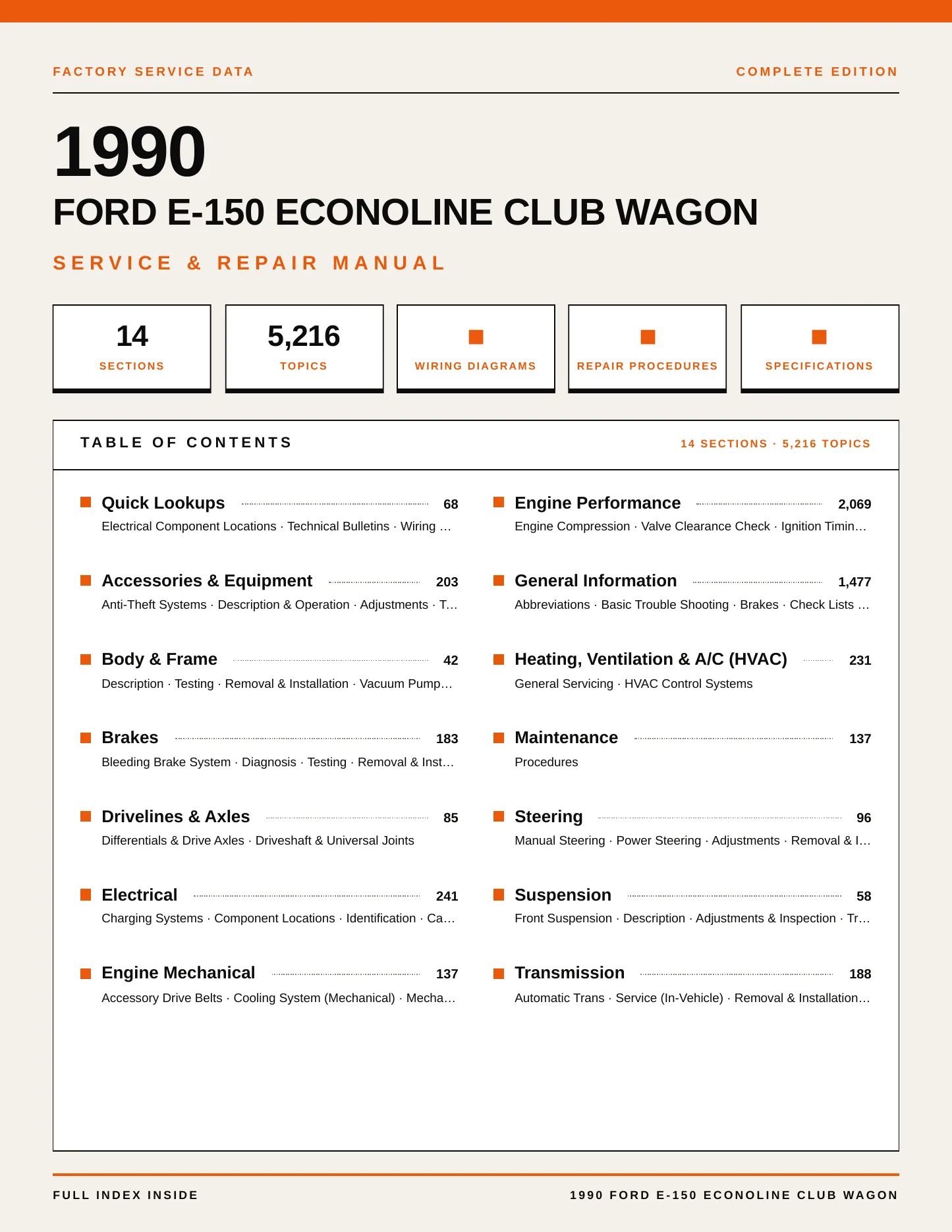
This factory service and repair manual for the 1990 Ford E-150 Econoline Club Wagon is written for the two-door standard passenger van in Custom, XL and XLT trim. Three gasoline engines are documented: the 4.9L inline-six of 300 cubic inches, the 5.0L V8 of 302 and the 5.8L V8 of 351, all overhead-valve and naturally aspirated. Whichever is under the hood, the wagon's procedures, specifications, torque values, wiring diagrams and diagnostics are found in the same system-based arrangement.
Engines covered
Body styles covered
Trims covered
Known issues on the 1990 E-150 Econoline Club Wagon. Three recalls are on federal record. Seat belt anchorage bars could pull through the floor under the loads of the federal test, a dual tank selector valve could overflow fuel past the filler cap, and a fractured snap ring could leave the transmission park gear unable to engage. Owners have filed 15 complaints with NHTSA, most of them about the fuel system, with wheels and service brakes behind. Fuel storage, brake and driveline procedures with their torque values and diagnostics are all in this manual.
THE DUAL FUEL TANK SELECTOR VALVE MAY MALFUNCTION AND CAUSE AN OVERFILL CONDITION IN ONE OF THE FUEL TANKS, RESULTING IN AN OVERFLOW OF FUEL PAST THE FILLER CAP.
UNDER CERTAIN CONDITIONS, THE SNAP RING THAT LOCATES THE PARK GEAR ON THE OUTPUT SHAFT OF THE TRANSMISSION MAY FRACTURE.
SAFETY BELT ANCHORAGES DID NOT MEET LOAD REQUIREMENTS OF FMVSS 210; BELT ANCHORAGE BAR PULLED THROUGH THE FLOOR OF VEHICLE WHEN SUBJECTED TO LOADS OF FMVSS 210 TEST.
GAS SPEWING FROM GAS CAP INPUT AREA DURING PERIODS OF WARM WEATHER. GAS CONTINUES TO SPEW REGARDLESS OF AMOUNT OF GAS IN EITHER TANK. HIGH POTENTIAL FOR FIRE AND LOSS OF LIFE. FORD KNOWS OF THIS PR
THERE IS A FUEL LEAK THAT BEGAN A WHILE BACK BUT ONLY WHEN BOTH TANKS WERE FULL. NOW THE LEAK IS SUBSTANTIAL AND SEEMS TO OCCUR EVEN WHEN LESS THAN FULL....BUT NOT AT ALL WHEN ABOUT HALF FULL. I AM NO
Showing the 2 most serious of 15 complaints filed with NHTSA.