
Be the first to write a review
0%
(0)
0%
(0)
0%
(0)
0%
(0)
0%
(0)
Labor Day Sale: 30% off · Code LABOR30


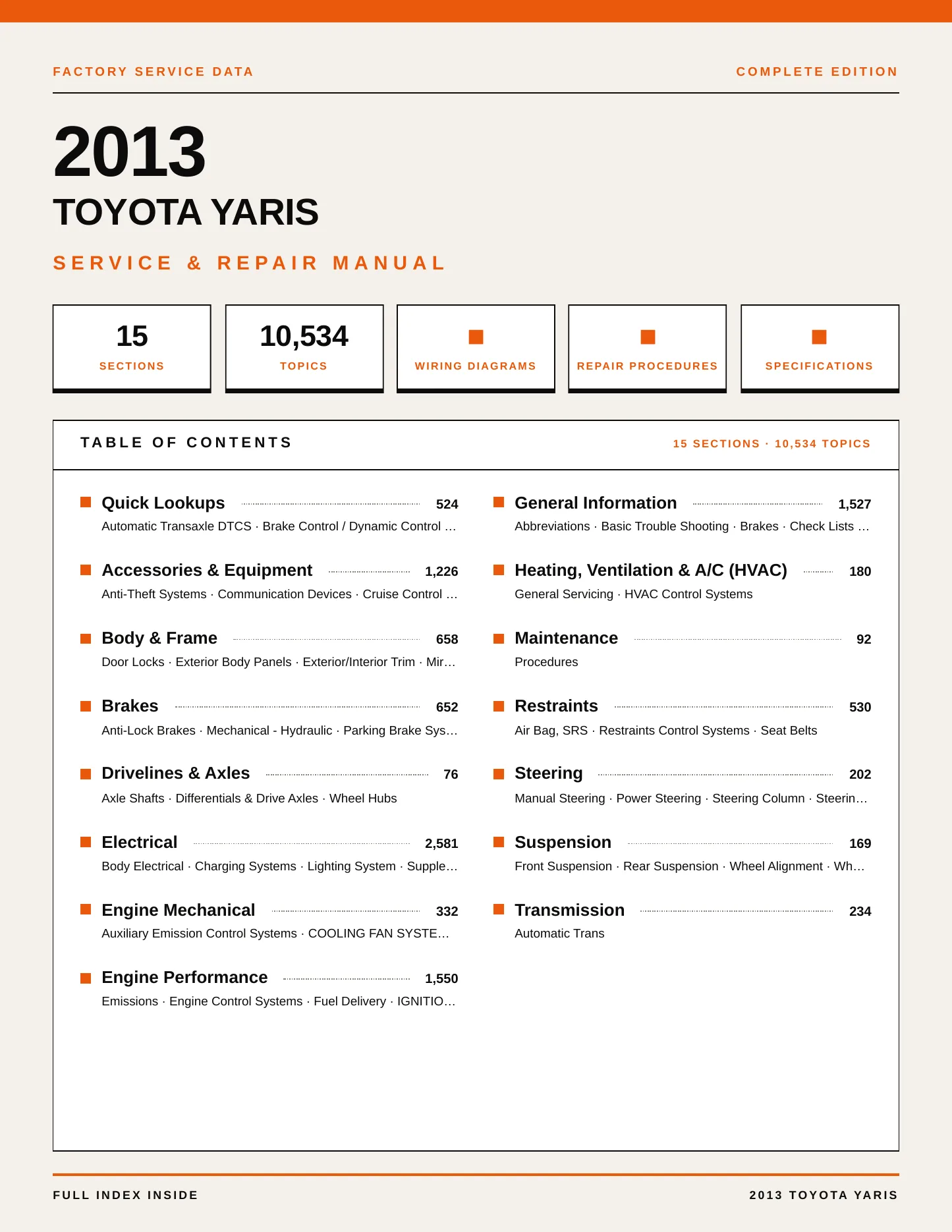
2013 Toyota Yaris Service and Repair Manual

Toyota wrote this factory service and repair manual for the 2013 Yaris as it was actually built that year, matched to the 1.5L four-cylinder (1NZ-FE) and to the specific trim and transmission combination in front of you, so the specifications and service sequences you work to belong to this car rather than being numbers inherited from a different production year of the same nameplate.
Engines
Trims
Known issues on the 2013 Yaris. One recall stands on the federal record for this model year, and it is a limited one: Toyota recalled certain model year 2012-2015 Yaris vehicles manufactured August 31, 2011, to February 9, 2015, and sold or registered in Puerto Rico, over vehicle structure, because those cars may be equipped with a headliner that does not meet the impact requirements. Owners have reported 11 complaints for the year, and Toyota has issued 90 technical service bulletins against it.
Whether the job is one of those 90 bulletined conditions, checking recall status on a car sold in Puerto Rico, or routine service on the 1.5L four-cylinder, the procedure you follow and the figure you torque to are Toyota's own for the 2013 Yaris.
Toyota Motor Engineering & Manufacturing (Toyota) is recalling certain model year 2012-2015 Yaris vehicles manufactured August 31, 2011, to February 9
If the vehicles are equipped with a headliner that does not meet the impact requirements, there is an increased risk of
Toyota will notify owners, and dealers will replace the headliner, free of charge. The recall began on June 22, 2015. O
Some 2005 2026 Toyota vehicles that have undergone water intrusion may exhibit a condition in which a musty odor is present. Follow the procedures in this bulletin to remediate the odor and address this condition. The purpose of this Servic
The air conditioning dye injection tool kit has been developed to aid in identifying the location of air conditioning refrigerant leaks. The procedures outlined in this Service Bulletin aid in locating, inspecting, and repairing refrigerant
The condition known as acid rain is caused by airborne chemicals or particles in the atmosphere, which mix with rainwater, nighttime dew, or high humidity to form acidic compounds. If these contaminants settle and remain on a painted vehicl
To prevent brake rotor rust from forming during transportation and storage, wheel film will be used instead of a cardboard type of anti-rust cover. The purpose of the wheel film is to shield the disc brake rotor from weather elements and in
Acid rain results from rainwater or other airborne moisture that become acidic due to industrial chemical impurities in the atmosphere. If these acidic compounds settle on an exposed vehicle, especially the horizontal areas such as the hood
Toyota vehicles are currently protected with RapgardTM protective film designed to protect the horizontal painted surfaces. This material protects from acid rain, environmental fallout, and rail contamination. Follow the Removal Procedure i
Vehicles may occasionally be subjected to contamination by airborne iron particles shed from railroad tracks, train wheels, exposure to heavy machinery facilities, grinding, welding, etc. This type of contamination can be identified by the
Some 2005 2024 Toyota vehicles that have undergone water intrusion may exhibit a condition in which a musty odor is present. Follow the procedures in this bulletin to remediate the odor and address this condition. The purpose of this Servic
Showing the 8 most recent of 210 technical service bulletins on file with NHTSA.
TL* THE CONTACT OWNS A 2013 TOYOTA YARIS. WHILE DRIVING APPROXIMATELY 50 MPH, THREE DEER JUMPED IN FRONT OF THE CONTACT'
MY DAUGHTER WAS DRIVING ON THE HIGHWAY, THINKS THAT SHE MUST HAVE HIT A PATCH OF ICE BECAUSE THE CAR SUDDENLY FELT OUT O
OUR DAUGHTER WAS DRIVING OUR 2013 TOYOTA YARIS ON THE HIGHWAY APPROXIMATELY 60-65MPH, HIT A PATCH OF ICE AND SPUN OUT.
THE CAR TILT TO THE RIGHT, SOMETIMES WOBBLES ON THE ROAD. AT SOME CURBS APPLIES THE ANTILOCK AT THE RIGHT NO MATTER. THI
SOMETIMES WOBBLES ON THE ROAD. WHEN BRAKES ARE APPLY IN A QUICK STOP, IT FEELS LIKE IT WILL NOT STOP. IT MAKES A NOISE.
Showing the 5 most serious of 9 complaints filed with NHTSA.