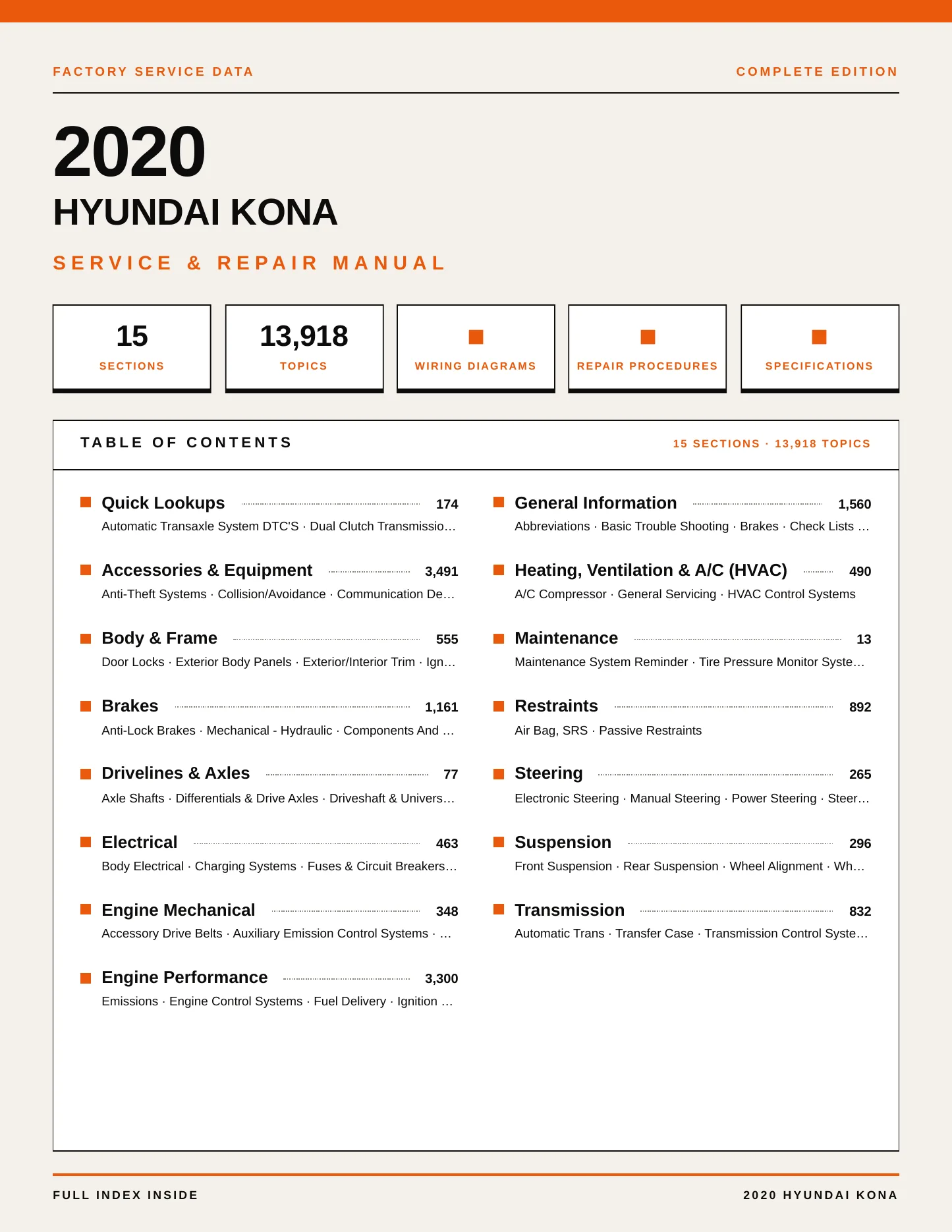
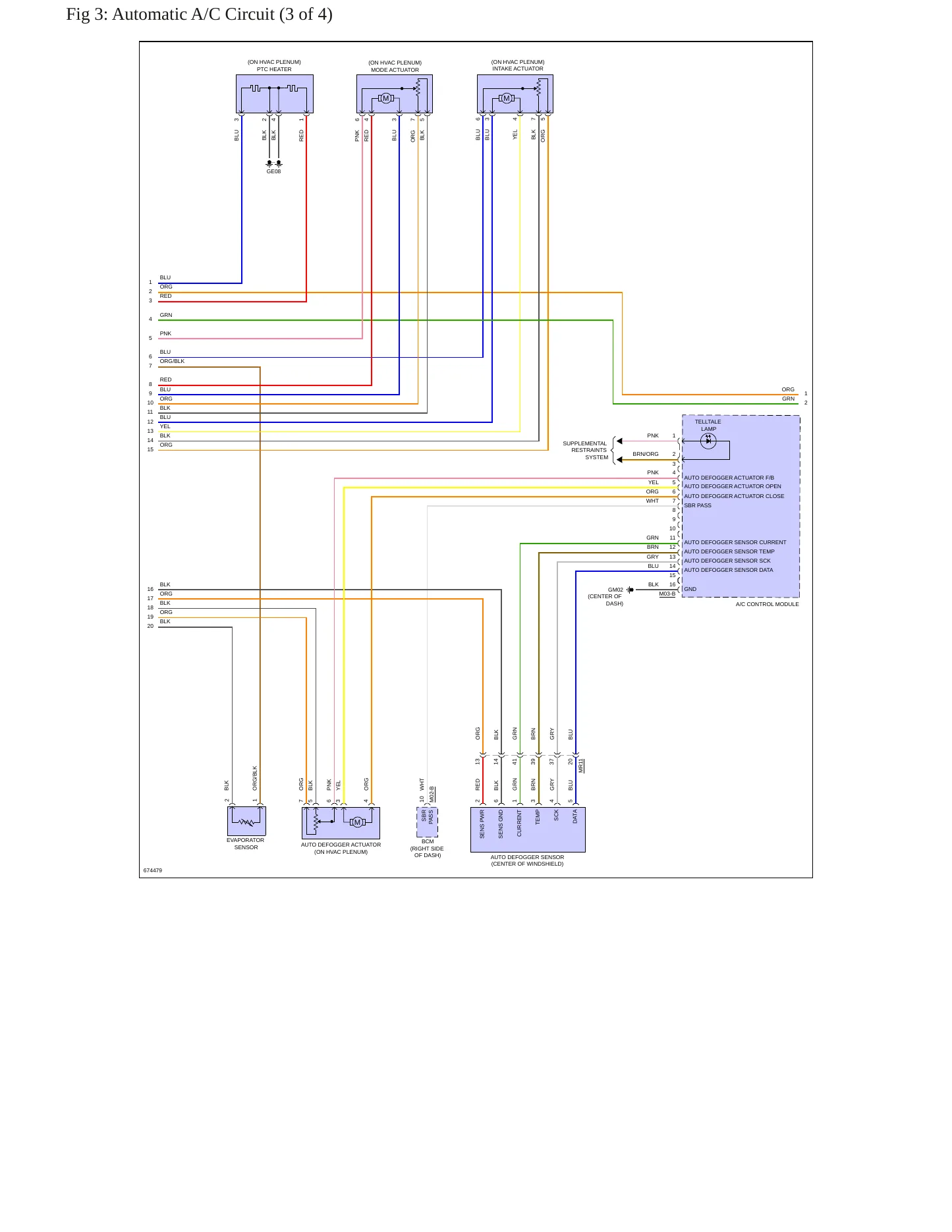
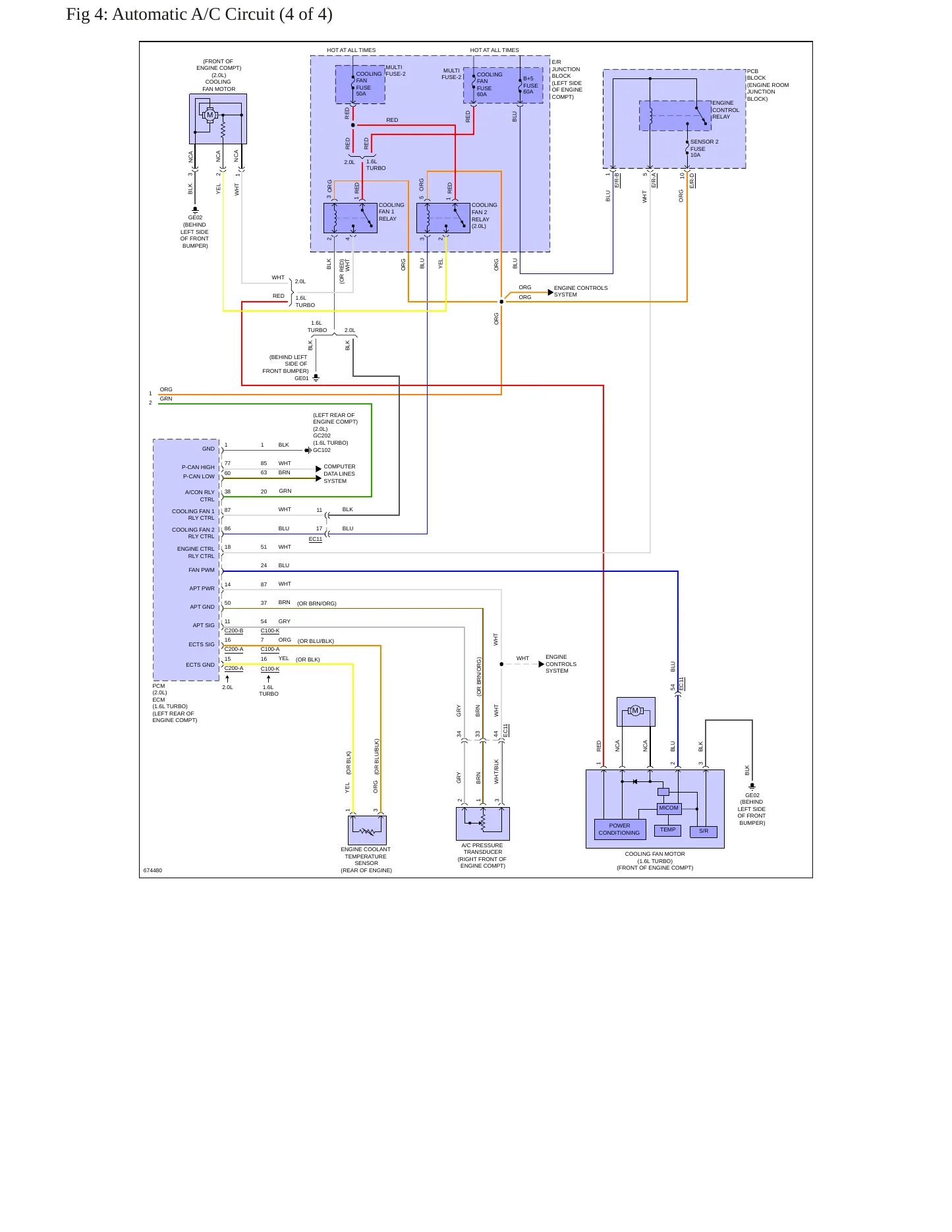
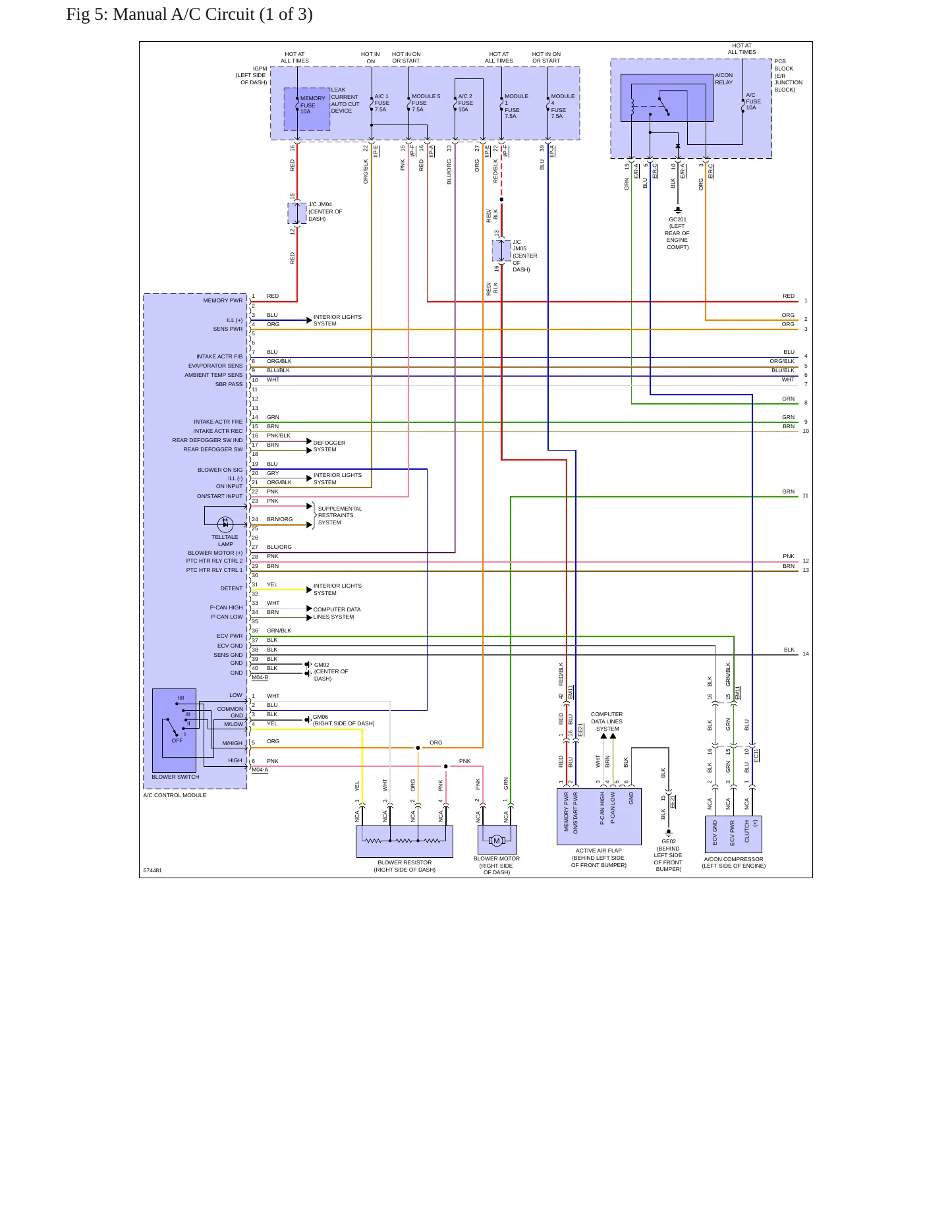
2020 Hyundai Kona Service and Repair Manual
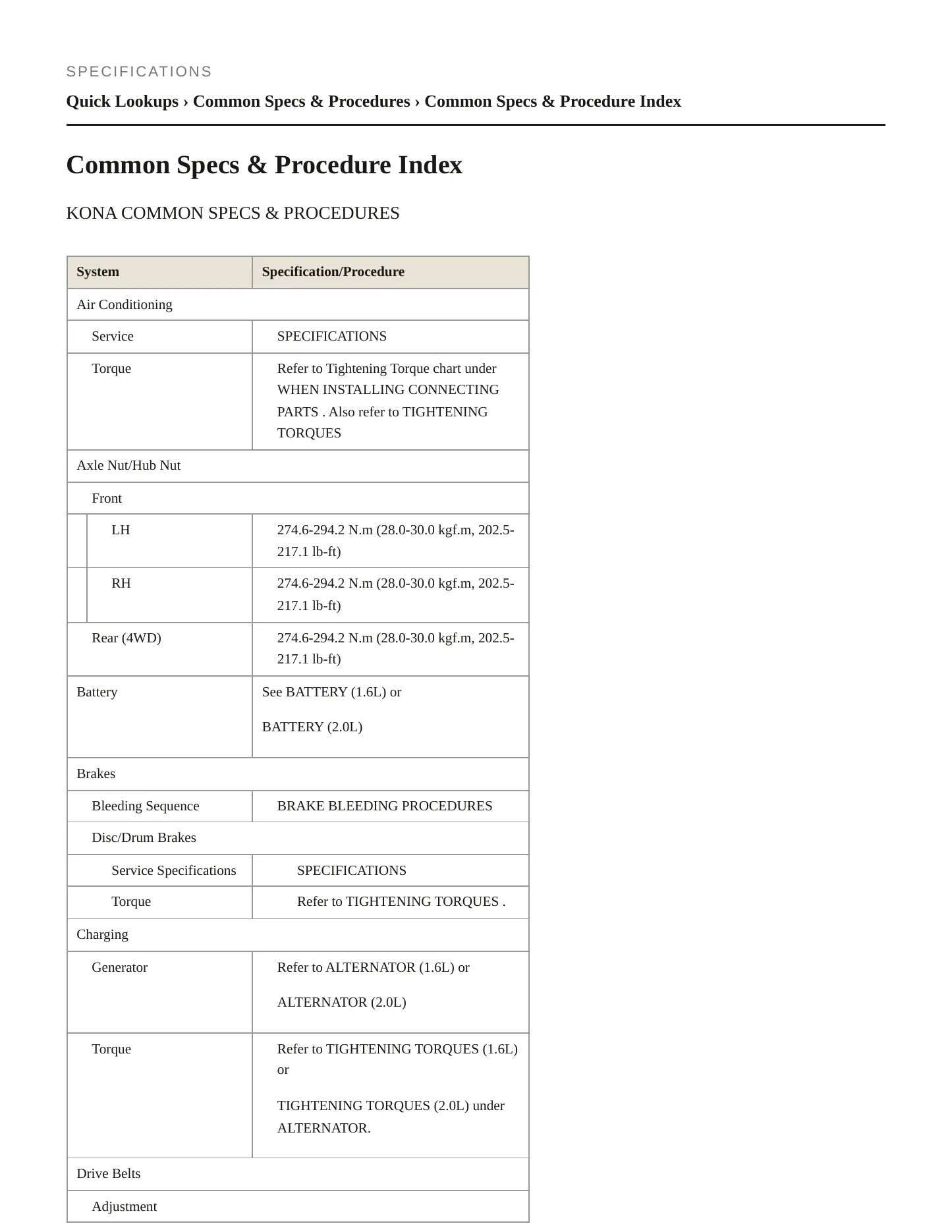
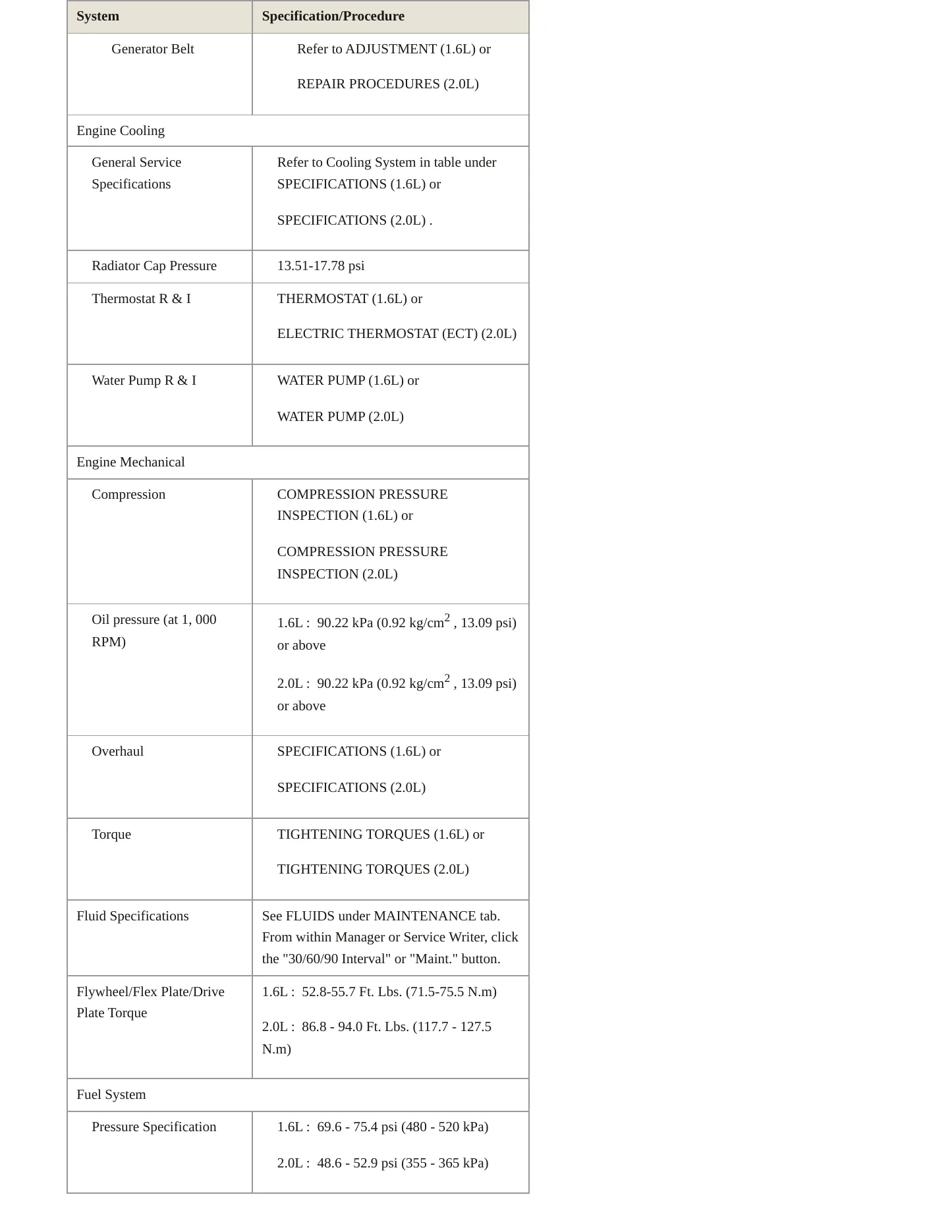
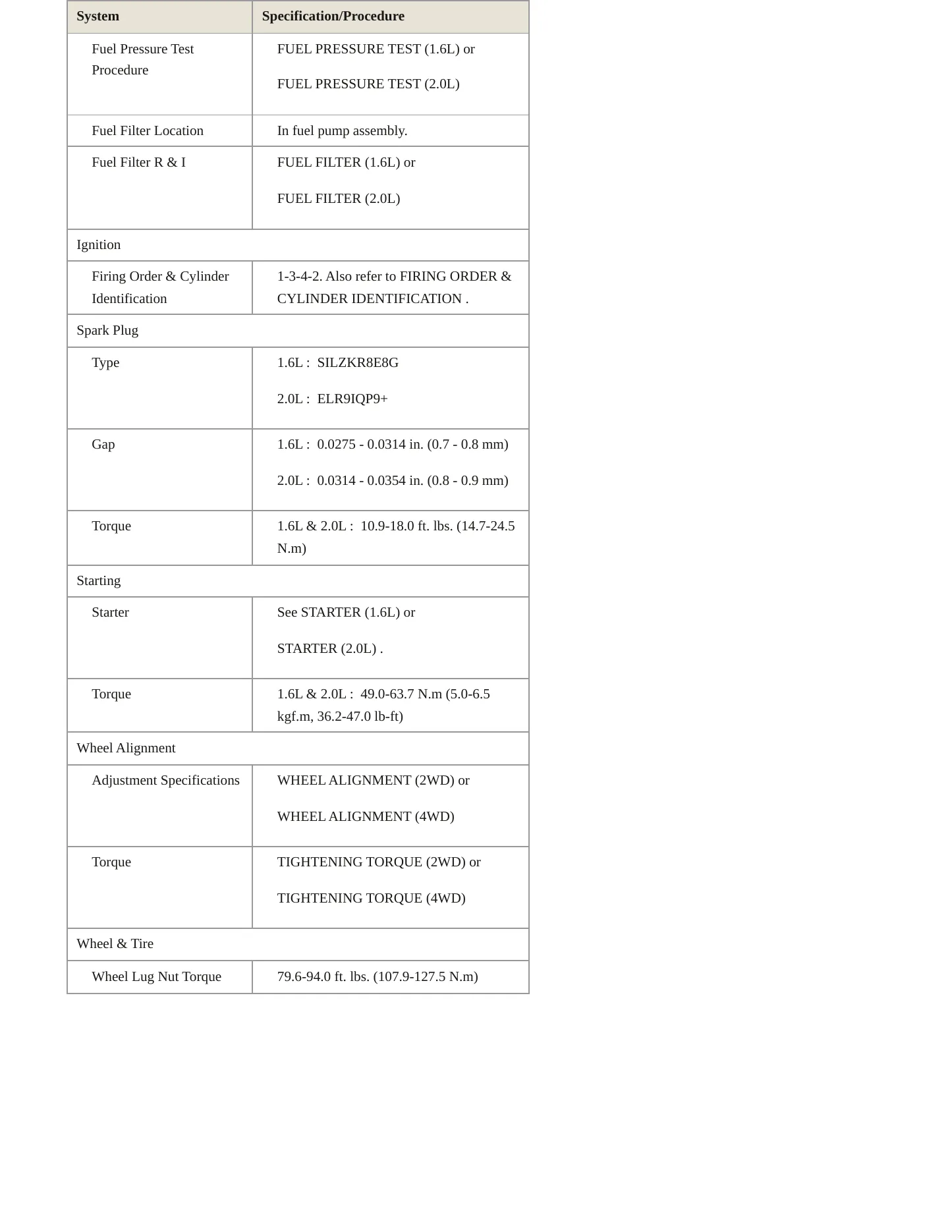
Every specification and torque sequence in the 2020 Hyundai Kona factory service and repair manual is the one Hyundai published for this precise year, engine and trim combination — none of it is a near-match figure borrowed from an adjacent model year's documentation.
Engines covered
- 2.0L inline-four — DOHC, naturally aspirated, gasoline
- 1.6L inline-four (97 cu in) — DOHC, turbocharged, gasoline
Body styles covered
- 4-door sport utility
Trims covered
- Essential
- Limited
- Luxury
- Preferred
- SE
- SEL
- SEL Plus
- Trend
- Ultimate
Known issues on the 2020 Kona. Two recalls are on federal record for this model year. The first covers the engine: it applies to Konas equipped with the 2.0L Nu MPI engine and concerns the piston oil rings, and a damaged engine may stall, increasing the risk of a crash. The second covers the certification label, which may indicate an incorrect Gross Axle Weight Rating (GAWR); an incorrect GAWR could result in the vehicle being overloaded, increasing the risk of a crash. Owners have filed 187 complaints for the year and Hyundai has issued 81 technical service bulletins.
From diagnosing a stall on the 2.0L to confirming the correct axle weight ratings before you load the car, it keeps you on Hyundai's own procedure and the correct specification for your specific 2020 Kona.
Hyundai Motor America (Hyundai) is recalling certain 2019-2020 Elantra, 2019-2021 Kona and Veloster vehicles equipped with 2.0L Nu MPI engines. The piston oil rings may not have been properly heat-treated, which could result in engine damage.
A damaged engine may stall, increasing the risk of a crash. In addition, oil may leak onto hot exhaust components, increasing the risk of a fire.
Dealers will inspect and, if necessary, replace the engine, free of charge. In addition, Hyundai will deploy Piston Ring Noise Sensing System (PNSS) software. Owner notification letters were mailed August 24, 2021. Owners may contact Hyundai customer service at 1-855-371-9460.
Hyundai Motor America (Hyundai) is recalling certain 2020 Kona vehicles. The certification label may indicate incorrect Gross Axle Weight Rating (GAWR). As such, these vehicles fail to comply with the requirements of Federal Motor Vehicle Safety Standard (FMVSS) numbers 567, "Certification" and 110, "Tire Selection and Rims."
An incorrect GAWR could result in the vehicle being overloaded, increasing the risk of a crash.
Hyundai will notify owners, and dealers will install new label stickers displaying the correct GAWR over the affected areas of the certification label, free of charge. The recall began March 2, 2020. Owners may contact Hyundai customer service at 1-855-371-9460. Hyundai's number for this recall is 187.
The National Highway Traffic Safety Administration (NHTSA) has identified the presence of substandard and dangerous drivers-side airbag inflators manufactured by Jilin Province Detiannuo Automobile Safety System Co., Ltd. (DTN). These infla
The National Highway Traffic Safety Administration (NHTSA) has issued an urgent safety advisory regarding dangerous, counterfeit driverside airbag inflators manufactured by Jilin Province Detiannuo Automobile Safety System Co., Ltd. (DTN),
Some vehicles may exhibit difficulty starting in cold weather. This bulletin provides the procedure to perform an inspection on the starter magnetic switch for potential freezing and, if necessary, replace the starter magnetic switch (solen
A Class Action settlement regarding the TRW Airbag was recently decided. Based on the Class Action, customers are eligible for certain settlement benefits. Please see attached for details. Impacted vehicles are also noted below. For further
A Class Action settlement regarding the TRW Airbag was recently decided. Based on the Class Action, customers are eligible for certain settlement benefits. Impacted vehicles are also noted below. For further information regarding settlement
Hyundai has settled a class action lawsuit that alleges that certain Hyundai and Kia Class Vehicles (defined below) contain defective ZF-TRW airbag control units (ZF-TRW ACUs) that are vulnerable to a condition called electrical overstress,
Upon customer's request ONLY, the Technical Service Bulletin (TSB) 25-01-089H provides the service procedure for installation of a key cylinder reinforcement protector assembly and two anti-theft decals on the front windows. This repair pro
In addition to the Anti-Theft software provided under Service Campaign 993 (TSB 24-01-009H-1), a zinc reinforced ignition cylinder protector hardware upgrade is being made available to customers upon request. This supplemental security meas
Showing the 8 most recent of 81 technical service bulletins on file with NHTSA.
On 30 May 21, I was getting ready to pull into my driveway, stopped the vehicle to let a passenger out of car, when suddenly the vehicle accelerated at a high speed crashing into my house. I nor the braking assist could stop the vehicle, resulting in the collision with house. I and my passengers sustained seat belt injuries.
The Hyundai Kona was struck head-on by another vehicle. There was one driver and one minor passenger in the right rear seat in the Hyundai Kona. The driver had minor injuries while, unfortunately, the accident was fatal to the passenger. The impact of the collision caused the right rear seat to snap forward, fracturing the passenger's neck. The cause of death for the passenger was blunt force trauma caused by the neck fracture. If the seat had stayed in place during the impact, the passenger's n
TL* THE CONTACT'S CLIENT OWNS A 2020 HYUNDAI KONA. THE CONTACT STATED THAT THE CLIENT WAS GONG THROUGH AN INTERSECTION AND ANOTHER DRIVER RAN A RED LIGHT AND BROADSIDED THE CONTACT'S VEHICLE. BOTH THE CLIENT AND HER PASSENGER WERE INJURED AND HAD TO BE TRANSPORTED TO THE HOSPITAL. THE DRIVER HAD NECK AND BACK PAINS AND HER RIGHT HAND HAD A BUMP. THE PASSENGER HAD HEAD AND NECK INJURIES AND HAD A BRAIN BLEED ISSUE AND HIP INJURIES. THE PASSENGER ALSO HAD A KNOT ON THE SIDE OF HER HEAD. THE OTHER
2020 HYUNDAI KONA. CONSUMER WAS IN AN AUTO ACCIDENT WHERE THE AIRBAGS DID NOT DEPLOY. *LD THE CONSUMER STATED THE VEHICLE WAS INVOLVED I AN ACCIDENT WHERE THE SIDE CURTAIN AIRBAGS DID NOT DEPLOY. THE PASSENGER WAS SEVERELY INJURED. *JS*DT*JB
The contact owns a 2020 Hyundai Kona. The contact stated while driving at 20 MPH, the AEB system inadvertently engaged causing the vehicle to decelerate and accelerate on its own. As a result, the contact lost control of the vehicle and crashed into another vehicle. The air bags did not deploy. The contact stated several warning lights were illuminated and there was smoke coming from the hood. The contact sustained injuries on the neck and shoulder but did not seek medical assistance at the time
I stopped my car foot on brake put it in park and it accelerated on its own and forced me to crash into a concrete wall still not wanting to stop
ON TUESDAY, MARCH 2020, I PULLED INTO A PARKING SPACE AT A LOCAL CVS STORE SHORTLY AFTER 5 PM, ABOUT TO COME TO A COMPLETE STOP AND SHIFT INTO PARK, WHEN MY 2020 HYUNDAI KONA SUDDENLY AND INEXPLICABLY ACCELERATED, JUMPED THE POLICEMAN, THEN THE CURB AND RAMMED INTO THE WALL OF CVS STORE. MY AIRBAG WAS ACTIVATED AND THE CAR ROLLED BACK AFTER THE IMPACT. THERE WAS NO DAMAGE TO THE WALL AND THE SHERIFFS DEPUTY WHO ARRIVED AFTER THE CAR'S EMERGENCY NOTIFICATION SYSTEM WAS ACTIVATED DID NOT MAKE A RE
Accident due to recall
The Kona was driven a 1/2 hour before parking the vehicle. The Kona was turned off. Within 5 minutes smoke began wafting from under the hood. When I opened the hood to inspect I found the engine & underside of the hood was engulfed in flames. I closed the hood immediately. The Kona fully ignited with minor explosions & burnt completely to the metal frame within 25 minutes.
On 3/29/26 my Kona caught fire while parked in the front left side of the engine and burned completely within eight minutes. This is not an electric car. Prior to that I drove the car all day with no incident. It was later in the evening around 5:40 PM. I had driven from my house to a restaurant which is about 6.8 miles from my house. I parked my car and then my son-in-law noticed that my engine was smoking. My husband went to check to see if it was the radiator, but he noticed that it was fire
The contact owns a 2020 Hyundai Kona. The contact stated while driving the vehicle stalled. The gear shifter was stuck in reverse and drive. The vehicle was taken to the local dealer who informed the contact the vehicle was working as designed. The vehicle was not diagnosed or repaired. The vehicle was towed to a local dealer where it was diagnosed the transmission needed to be replaced. The vehicle was repaired but, the failure recurred. The vehicle failed to turn on and there was an abnormal
Leased 5/24/2020. Poor mileage . Told had to break in. On 3/24, 3/29 and 3/30, 2020, car stalled out in traffic. Called for service and given date 3 weeks later. Called Another dealer and got appt. for next day.Spoke to Hyundai Ca. (Sonia) and got case number(1811 5897). On 4/2/2020Blue Link advised to take to dealership, that there was a problem with Engine Control System.The service report was written up that customer states check engine light on.We told them that the car stalled in traffic(ve
Check engine light came on and car lost power while driving.
...three times in one week (twice with me, and once with my wife), while driving in traffic the engine shut down completely, and we had to coast off the road to restart the engine...could easily have been deadly...I have tried to contact my dealer, but continually on hold...have left message for call back...afraid to drive car...
Letter below was sent to Hyundai corporate 7 Feb 22. They replied I should work with my Dealership to resolve the issue. Dealership cannot duplicate the fault. Vehicle has 7 speed DCT and currently has about 40k miles. "SUBJECT: 2020 Hyundai Kona DCT disengages and/or makes loud banging noise upon normal acceleration from standing stop. Occurrence is random but more prevalent in warm weather. ISSUE: While our Kona has been a mostly faithful servant over the last 17 months, including
Showing the 15 most serious of 156 complaints filed with NHTSA.