
Be the first to write a review
0%
(0)
0%
(0)
0%
(0)
0%
(0)
0%
(0)
Labor Day Sale: 30% off · Code LABOR30


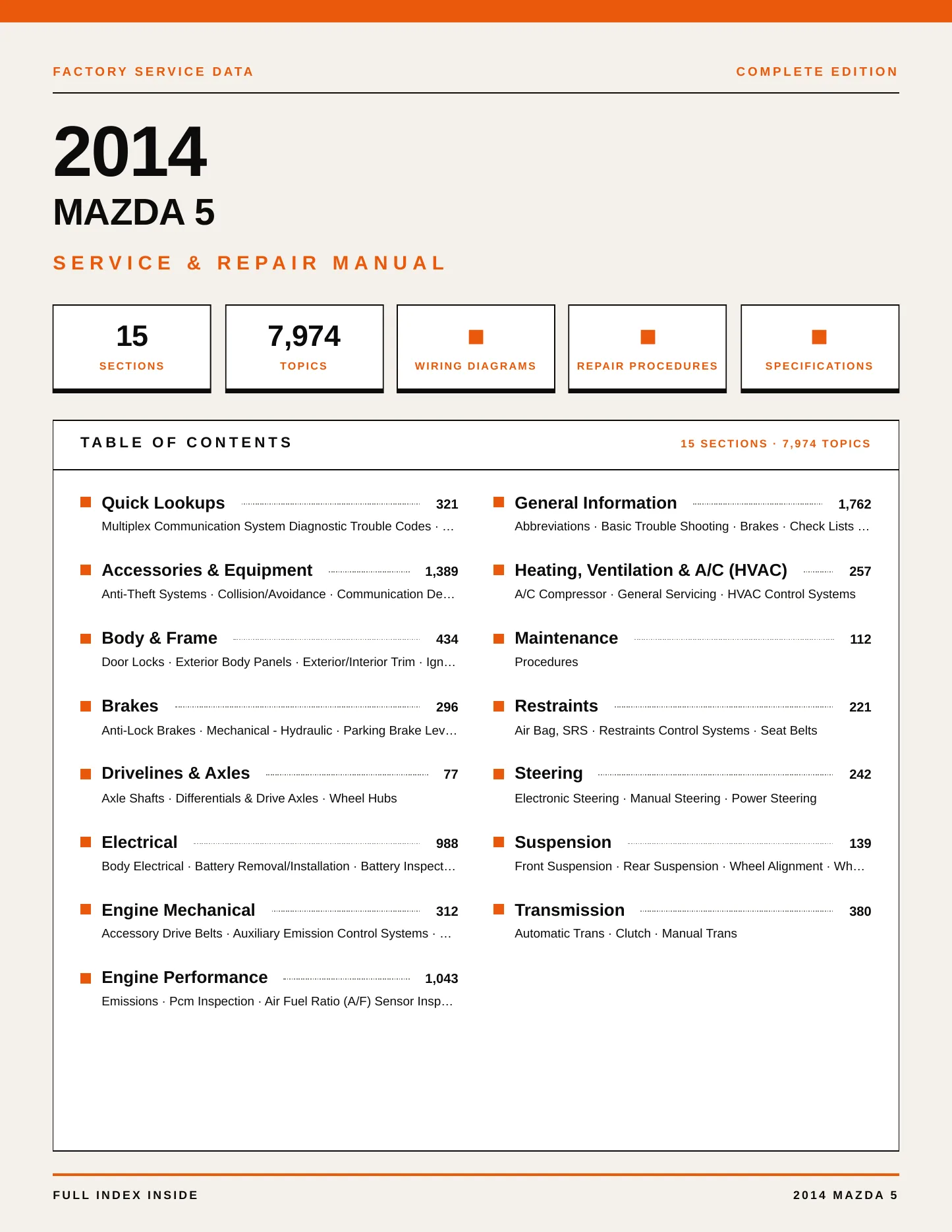
2014 Mazda 5 Service and Repair Manual

This manual is built for the 2014 Mazda 5 specifically, matched to its year, engine and trim, so the specs and procedures inside are the ones Mazda published for this van and its 2.5L L4 (VIN L) engine rather than a generic figure pulled from another model year.
Engines covered
Body styles covered
Trims covered
Known issues on the 2014 5. No recalls are on federal record for the 2014 5, and no complaints are logged for the year either.
Whether you're working through the 2.5L engine, a suspension inspection, or a routine service interval on any of the five trims, it keeps you on the OEM procedure and the correct specification for your specific 2014 Mazda 5.
Mazda North American Operations (Mazda) is recalling certain model year 2010-2013 Mazda3 and Mazdaspeed3 vehicles manufactured November 18, 2008, to June 8, 2013, 2012-2015 Mazda5 vehicles manufactured October 26, 2010, to June 22, 2015, 2016 CX-3 vehicles manufactured June 1, 2015, to December 26, 2015, and 2013-2016 CX-5 vehicles manufactured December 15, 2011, to December 26, 2015. On the affected vehicles, the lift gate support struts may corrode, possibly causing the struts to break and/or the lift gate to drop unexpectedly.
If the lift gate falls unexpectedly, it may hit the user, increasing their risk of injury.
Mazda dealers will replace the both lift gate supports, free of charge, however parts are not currently available. The recall began April 2017. Owners may contact Mazda customer service at 1-800-222-5500. Mazda's number for this recall is 9916H.
This Service Alert supersedes the previously issued SA listed below: The changes are noted in Red. SA-011/24 02/12/24, 06/06/24, 07/29/24 DESCRIPTION Mazda has developed factory recommended scheduled maintenance services that support all ma
If you encounter any type of electrical concern (e.g, dead battery, engine no start, DTC(s) stored...), interview the customer before proceeding with normal MGSS diagnosis by asking if any aftermarket devices have been installed. Aftermarke
A musty/mildew type odor may come from the vents when the air conditioning (A/C) system is operating. It is most noticeable when the A/C is first turned ON. This odor is the result of mold growth in the A/C evaporator/cooling unit which is
Some vehicles may experience exterior trim heat damage such (melted, separating, etc.) when parked near a glass building or Low-E windows. This may be caused by the sun's reflection. If a structure's windows create enough of a curve, the co
When replacing the SiriusXM satellite radio unit, a call must be made to inform SiriusXM of the existing Radio ID and the new/replacement SAT Radio ID as soon as possible to ensure the customer leaves the dealership with an active SAT radio
Some customers may complain about a noisy HVAC blower motor or odor after a cabin air filter replacement. Foreign debris on the blower motor after servicing the cabin air filter may be the cause. During the removal of the cabin air filter,
A musty/mildew type odor may come from the vents when the air conditioning (A/C) system is operating. It is most noticeable when the A/C is first turned ON. This odor is the result of mold growth in the A/C evaporator/cooling unit which is
Some customers may complain about scratches on the instrument cluster lens.
Showing the 8 most recent of 131 technical service bulletins on file with NHTSA.
I bought this vehicle as is, about 2 months past, after driving it home I felt after pressing the Brakes pedal that it is not responding until I press 2 or 3 times. I went bnack to the dealer the next day and made a complain. They sent me to their Mechanic who diagnosed the problem to be the ABS Hydraulic Control Unit Assembly. It is available for inspection upon request. My safety and the safety of my family was put at risk because of the fact that I have to pump the brakes to slow the vehicle. Yes the problem was confirmed by the independent Mechanic recomended by the dealer, with a detailed
Power steering became stiff hard to turn, steering pulls left or right when driving over bumps on the road also brakes became spongy.
The car became hard to steer, and I noticed the power steering light was on. It is a safety risk due to increased difficulty steering car and a risk for myself and other drivers on the road. This just occurred today and has not been investigated by an other parties. No warning or incidents prior to steering becoming difficult.
The driver door handle stopped functioning on a 7-year-old low milage (<25k) Mazda 5. The malfunction is common among Mazda's and can be easily found when searching the internet. A small groove on the internal door handle mechanism breaks off and lets the spring pulling the handle back slip out. In most cases, this causes the door to be unable to open (from the outside or inside). However, in my case, the door would not latch closed anymore. Having a driver side door not close while driving is a safety issue and a vehicle where the door does not stay closed should not be operated. This proble
The contact owns a 2014 Mazda Mazda5. The contact stated that the passenger’s side rear door failed to open or close all the way. The contact stated that there was a 1-2-inch gap between the door and the door latch. The contact reached out to the local dealer to have the vehicle inspected however, the contact was unable to schedule an appointment for the vehicle to be inspected. The vehicle was not diagnosed nor repaired. The manufacturer was made aware of the failure. The failure mileage was 88,078.
The contact owns a 2014 Mazda Mazda5. The contact stated that while driving over a minor bump in the roadway at any rate of speed, the brake pedal would depress to floorboard without warning. The contact stated that the brakes would resume normal operation soon after failure. The contact had taken the vehicle to three separate independent mechanics however, each mechanic was unable to determine the cause of the failure. Neither the dealer nor the manufacturer were made aware of the failure. The vehicle was not yet repaired. The failure mileage was approximately 48,000.
WHEN APPLYING THE BRAKES, THE VEHICLE OFTEN HAS A CLUNKING SOUND AND A SLIGHT / BRIEF HESITATION BEFORE THE BRAKES ENGAGE. THE VEHICLE IS IN MOTION WHEN THIS OCCURS. I'VE HAD THE ISSUE INSPECTED ON MULTIPLE OCCASIONS (4-5 TIMES) AND WAS TOLD THERE IS NOTHING WRONG WITH THE BRAKES. I WAS INFORMED THAT IT IS POSSIBLE THAT IT IS BY DESIGN WHICH IS WHAT LED ME TO SUBMIT THIS REQUEST. THE ISSUE HAPPENS APPROXIMATELY 75-80% OF THE TIME. I DID NOT NOTICE THIS ISSUE WHEN THE VEHICLE WAS PURCHASED (NEW IN JAN, 2015) BUT NOTICED IT APPROXIMATELY 2 YEARS AFTER PURCHASE. SINCE THEN THE ISSUE HAS G
SINCE PURCHASE FROM DEALER, THE TIRES CONSISTENTLY DEVELOPED EDGE WEAR /CUPPING ON THE INNER EDGE OF BOTH FRONT AND BACK. THE FIRST SET WERE REPLACED AFTER APPROX 23K MILES. AFTER APPROX 25K MILES THE SAME PATTERN OF WEAR HAD OCCURRED FRONT AND BACK. AT FIRST WHEN THE CAR WAS PURCHASED, ALIGNMENT WAS INSPECTED AND I WAS TOLD THE MATTER WAS PROBABLY DUE TO POOR TIRES. WITH THE SAME PROBLEM OCCURRING AGAIN, I'VE CONTACTED MAZDA FOR ASSISTANCE.
Showing the 8 most serious of 12 complaints filed with NHTSA.