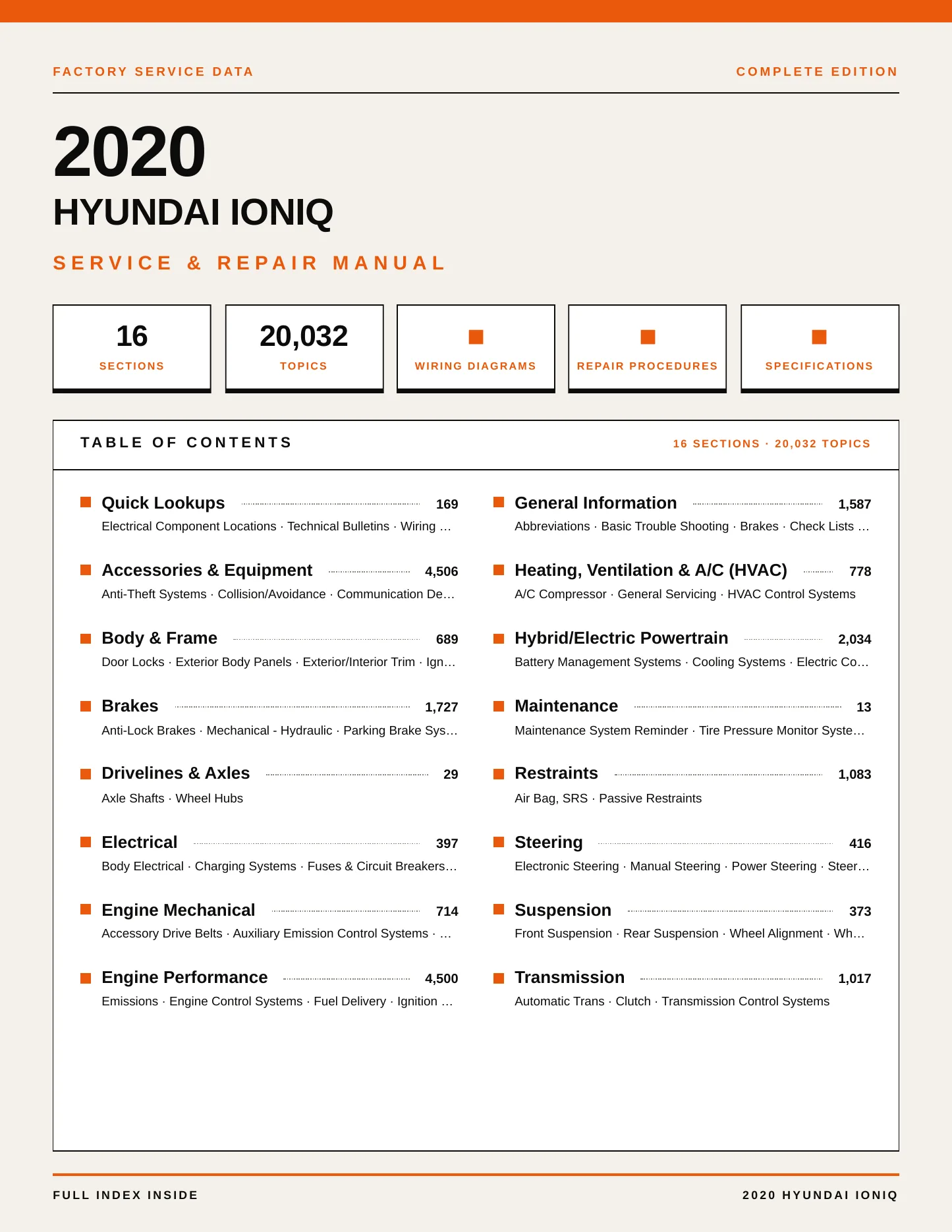
2020 Hyundai Ioniq Service and Repair Manual
Hyundai sold the 2020 Ioniq with three distinct powertrains: full hybrid, plug-in hybrid and battery electric. That makes borrowed service data unusually risky on this car. This factory service and repair manual is matched to your exact year, engine and trim, so every specification and sequence it gives is the one Hyundai published for the Ioniq in your driveway, not a figure carried over from a different variant or model year.
Engines covered
- 1.6L inline-four full hybrid (96 cu in) — DOHC, naturally aspirated, gasoline
- 1.6L inline-four plug-in hybrid (96 cu in) — DOHC, naturally aspirated, gasoline
- Battery-electric drive (EV)
Body styles covered
- 4-door hatchback
Trims covered
- Electric Limited
- Electric Preferred
- Electric SE
- Electric Ultimate
- GLS Premium
- Hybrid Blue
- Hybrid Essential
- Hybrid Limited
- Hybrid Luxury
- Hybrid Preferred
- Hybrid SEL
- Hybrid Ultimate
- Limited
- Plug-In Hybrid Limited
- Plug-In Hybrid Preferred
- Plug-In Hybrid SE
- Plug-In Hybrid SEL
- Plug-In Hybrid Ultimate
Known issues on the 2020 Ioniq. No recalls are on federal record for the 2020 Ioniq. Owners have filed a single complaint for the year, and Hyundai has issued 19 technical service bulletins.
Whichever of the three powertrains your car carries, the manual keeps you on the OEM procedure and the correct specification for your specific 2020 Ioniq.
This bulletin provides the procedure to update the BMS (Battery Management System), MCU (Motor Control Unit), VCULDC (Vehicle Control Unit / Low DC-DC Converter) and IGPM (Integrated Gateway Power Module) to enhance the battery diagnostics
This bulletin contains information about the proper removal of the windshield wiper blade protective cover on all models. If the protective cover is not removed correctly, there is a possibility of the rubber insert and rail spring becoming
This bulletin provides important checkpoint guidelines when performing engine oil and filter change services.
Hyundai applies a Paint Protection Film (PPF) on new vehicles before delivery to dealerships. It provides a barrier between the paint and contaminants, such as rail dust, acid rain, and industrial fallout. In rare cases, the paint can becom
This bulletin provides information regarding condensation related to the accumulated moisture in the headlamp, rear combination lamp, daytime running lamp (DRL), or fog lamp. This TSB illustrates the various causes of condensation inside th
Effective June 2, 2008, Federal Motor Vehicle Safety Standard 110 (FMVSS 110) established a threshold for correcting load carrying capacity information indicated on tire placards when vehicle weight has been increased before retail sale. Th
Follow the guidelines outlined in this bulletin to inspect and clean or replace certain components of the engine intake system accordingly during engine short block or sub-assembly replacement.
Certain vehicles may develop a bearing noise within the Motor Driven Power Steering (MDPS) column worm shaft assembly. If bearing noise is heard, follow the procedure in this bulletin to replace the worm shaft bearing.
Showing the 8 most recent of 19 technical service bulletins on file with NHTSA.
The contact owns a 2020 Hyundai Ioniq. The contact stated that while driving at undisclosed speeds, the vehicle stalled. No warning lights were illuminated. The contact was able to restart the vehicle. The vehicle was taken to the dealer where it was diagnosed and determined that the battery had overheated. The vehicle was not repaired. The contact stated that on a separate occasion, while driving at undisclosed speeds, the vehicle stalled. No warning lights were illuminated. The vehicle was tak