
Be the first to write a review
0%
(0)
0%
(0)
0%
(0)
0%
(0)
0%
(0)
Labor Day Sale: 30% off · Code LABOR30


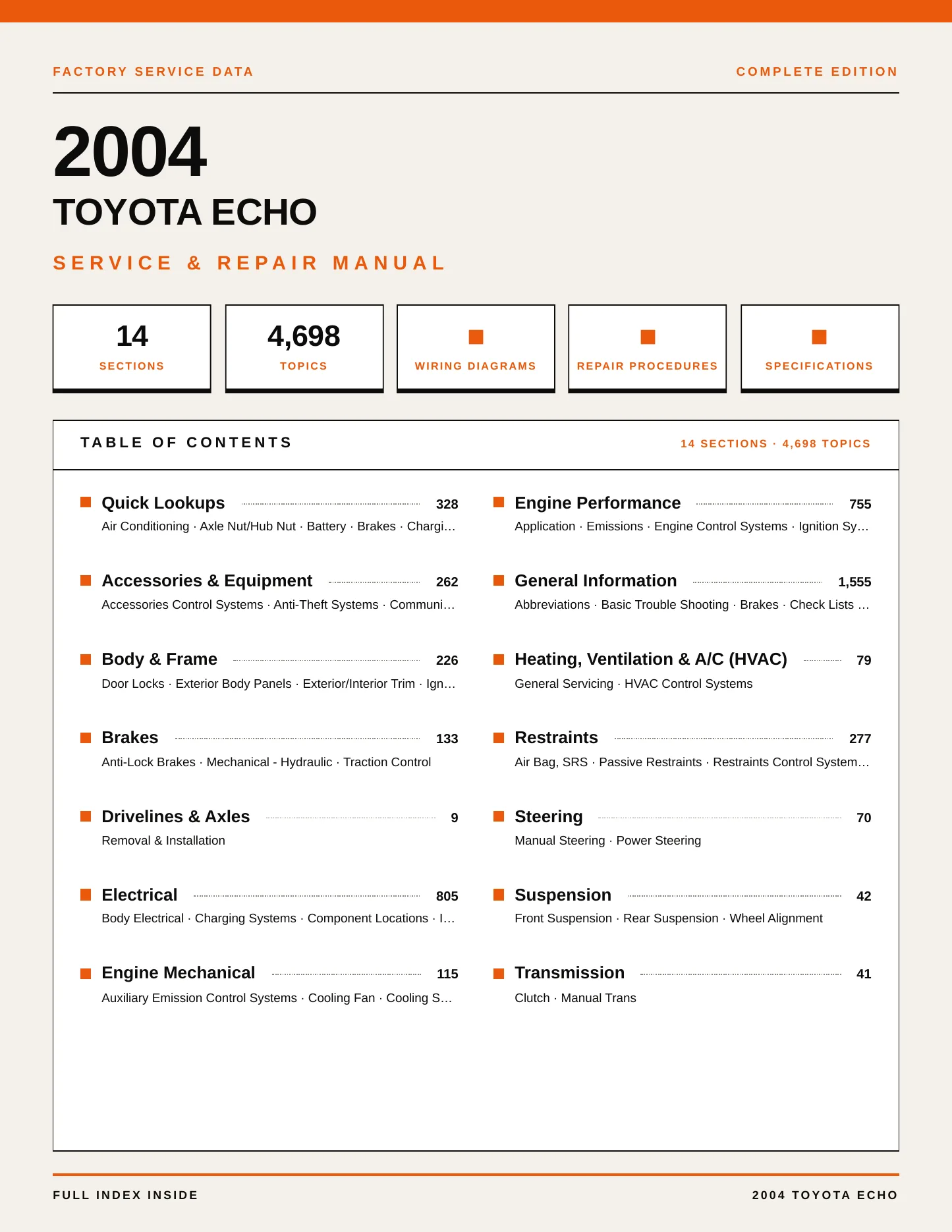
2004 Toyota ECHO Service and Repair Manual

The 2004 Toyota ECHO ran one engine across the entire range — the 1.5L four Toyota codes as the 1NZ-FE — so what changes from one car to the next is the body and the transmission, not the powertrain. The clearances and tightening sequences Toyota published against this model year are specific to 2004 rather than carried over from the years on either side of it.
Engines
Trims
Known issues on the 2004 ECHO. No recalls are on federal record for this car. Owners have registered 1 complaint against it, and Toyota has issued 46 technical service bulletins for the model year.
Whether the job in front of you is a scheduled service interval or chasing down the symptom behind one of those 46 bulletins, the procedure and the tolerance you work to are the ones Toyota specified for the 1.5L ECHO.
The condition known as acid rain is caused by airborne chemicals or particles in the atmosphere, which mix with rainwater, nighttime dew, or high humidity to form acidic compounds. If these contaminants settle and remain on a painted vehicl
To prevent brake rotor rust from forming during transportation and storage, wheel film will be used instead of a cardboard type of anti-rust cover. The purpose of the wheel film is to shield the disc brake rotor from weather elements and in
Acid rain results from rainwater or other airborne moisture that become acidic due to industrial chemical impurities in the atmosphere. If these acidic compounds settle on an exposed vehicle, especially the horizontal areas such as the hood
Toyota vehicles are currently protected with RapgardTM protective film designed to protect the horizontal painted surfaces. This material protects from acid rain, environmental fallout, and rail contamination. Follow the Removal Procedure i
The condition known as acid rain is caused by airborne chemicals or particles in the atmosphere, which mix with rainwater, nighttime dew, or high humidity to form acidic compounds. If these contaminants settle and remain on a painted vehicl
To prevent brake rotor rust from forming during transportation and storage, wheel film will be used instead of a cardboard type of anti-rust cover. The purpose of the wheel film is to shield the disc brake rotor from weather elements and in
Acid rain results from rainwater or other airborne moisture that become acidic due to industrial chemical impurities in the atmosphere. If these acidic compounds settle on an exposed vehicle, especially the horizontal areas such as the hood
The condition known as acid rain is caused by airborne chemicals or particles in the atmosphere, which mix with rainwater, nighttime dew, or high humidity to form acidic compounds. If these contaminants settle and remain on a painted vehicl
Showing the 8 most recent of 83 technical service bulletins on file with NHTSA.
TL*THE CONTACT OWNS A 2004 TOYOTA ECHO. WHILE STOPPED IN TRAFFIC, ANOTHER VEHICLE TRAVELING 40 MPH REAR ENDED THE CONTAC