
Be the first to write a review
0%
(0)
0%
(0)
0%
(0)
0%
(0)
0%
(0)
Labor Day Sale: 30% off · Code LABOR30


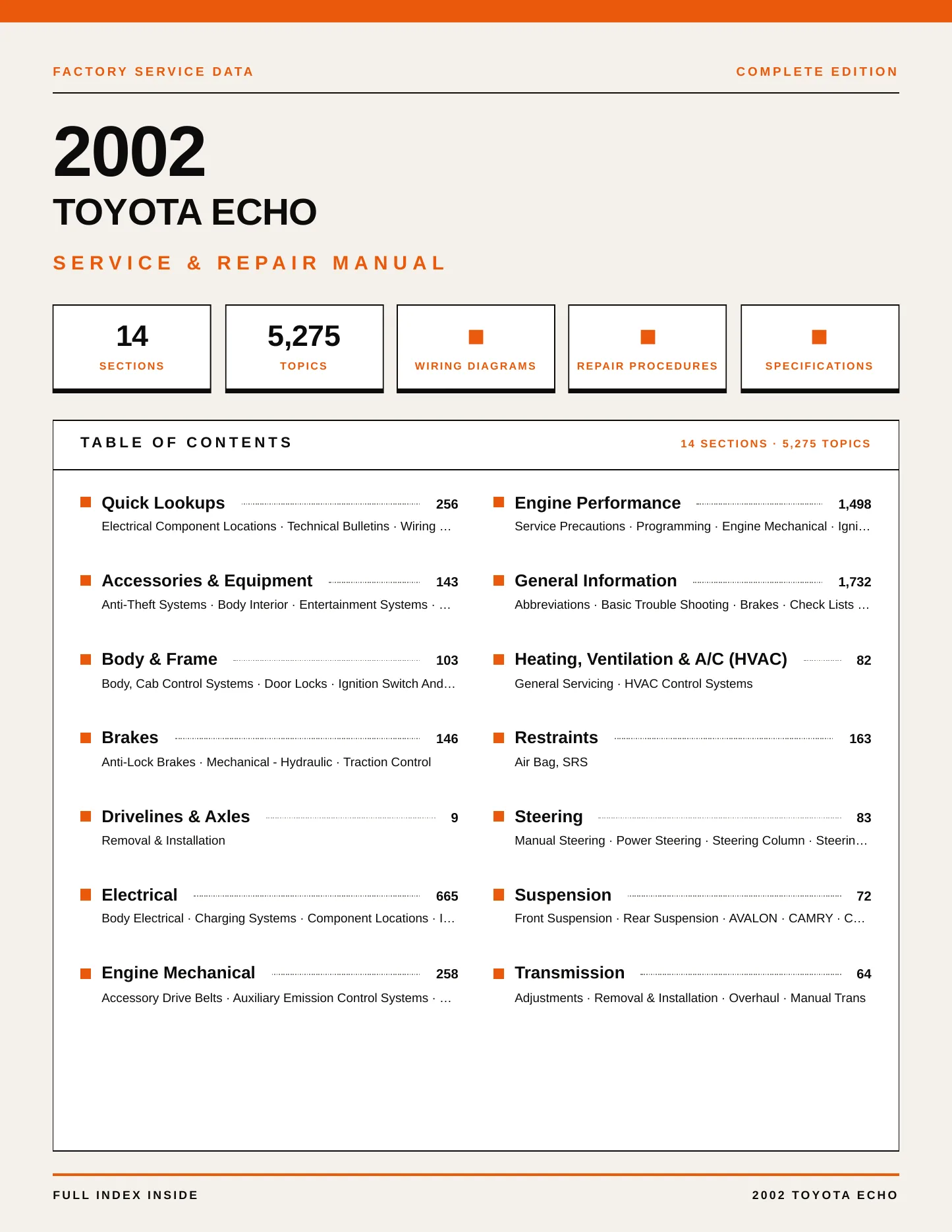
2002 Toyota ECHO Service and Repair Manual

This factory service and repair manual is tied to the 2002 Toyota ECHO in particular — the 1.5L four-cylinder (1NZ-FE) in the exact body and trim combinations Toyota sold that year — so the specifications and tightening sequences you work to are the ones Toyota published for this car, not figures carried over from an adjacent model year.
Engines
Trims
Known issues on the 2002 ECHO. Two recalls are on federal record for this model year. The first is filed under engine and engine cooling: improper molding of the resin body of the crankshaft position sensor installed on the engine block can let engine oil penetrate the seal and enter the sensor wiring connector, and engine oil inside that connector could cause expansion due to the heat of the engine. The second is filed under hydraulic service brakes, hoses and lines: driving under repeated start and stop operation in low ambient temperatures and in deep snow raises the possibility that snow could accumulate, and if that condition occurs frequently the rear brake line could be damaged. Owners have filed 45 complaints for the year and Toyota has issued 51 technical service bulletins.
Whether you are chasing oil in a crankshaft position sensor connector, inspecting the rear brake lines after a winter of deep snow, or working a scheduled service on the 1.5L four-cylinder, it holds you to Toyota's own procedure and figures for the 2002 ECHO.
ON CERTAIN PASSENGER VEHICLES, DUE TO IMPROPER MOLDING OF THE RESIN BODY OF THE CRANKSHAFT POSITION SENOR INSTALLED ON THE ENGINE BLOCK, ENGINE OIL MA
ENGINE OIL INSIDE THE SENSOR WIRING CONNECTOR COULD CAUSE EXPANSION DUE TO THE HEAT OF THE ENGINE AND COULD DEFORM THE S
DEALERS WILL REPLACE THE CRANKSHAFT POSITION SENSOR FREE OF CHARGE. THE RECALL BEGAN ON JULY 26, 2006. OWNERS MAY CONT
ON CERTAIN PASSENGER VEHICLES, IF THE VEHICLE IS DRIVEN UNDER REPEATED START AND STOP OPERATION IN LOW AMBIENT TEMPERATURES AND IN DEEP SNOW, THERE IS
IF THIS CONDITION OCCURS FREQUENTLY, THE REAR BRAKE LINE COULD BE DAMAGED, WHICH COULD RESULT IN LEAKAGE OF BRAKE FLUID,
DEALERS WILL REPLACE THE REAR BRAKE LINES. OWNER NOTIFICATION BEGAN NOVEMBER 9, 2002. OWNERS WHO TAKE THEIR VEHICLE
The condition known as acid rain is caused by airborne chemicals or particles in the atmosphere, which mix with rainwater, nighttime dew, or high humidity to form acidic compounds. If these contaminants settle and remain on a painted vehicl
To prevent brake rotor rust from forming during transportation and storage, wheel film will be used instead of a cardboard type of anti-rust cover. The purpose of the wheel film is to shield the disc brake rotor from weather elements and in
Acid rain results from rainwater or other airborne moisture that become acidic due to industrial chemical impurities in the atmosphere. If these acidic compounds settle on an exposed vehicle, especially the horizontal areas such as the hood
Toyota vehicles are currently protected with RapgardTM protective film designed to protect the horizontal painted surfaces. This material protects from acid rain, environmental fallout, and rail contamination. Follow the Removal Procedure i
The condition known as acid rain is caused by airborne chemicals or particles in the atmosphere, which mix with rainwater, nighttime dew, or high humidity to form acidic compounds. If these contaminants settle and remain on a painted vehicl
To prevent brake rotor rust from forming during transportation and storage, wheel film will be used instead of a cardboard type of anti-rust cover. The purpose of the wheel film is to shield the disc brake rotor from weather elements and in
Acid rain results from rainwater or other airborne moisture that become acidic due to industrial chemical impurities in the atmosphere. If these acidic compounds settle on an exposed vehicle, especially the horizontal areas such as the hood
The condition known as acid rain is caused by airborne chemicals or particles in the atmosphere, which mix with rainwater, nighttime dew, or high humidity to form acidic compounds. If these contaminants settle and remain on a painted vehicl
Showing the 8 most recent of 86 technical service bulletins on file with NHTSA.
ANOTHER VEHICLE TRAVELING NORTH, CROSSED CENTER LINE AND HIT DAUGHTER IN 2002 TOYOTA ECHO HEAD ON. AS A RESULT OF IMPACT
MY BOY FRIEND WAS DRIVING MY 2002 TOYOTA ECHO 2-DOOR COUPE. WE WERE DRIVING IN THE MIDDLE LANE ON THE OUTERLOOP OF 495
HAD AN SIDE IMPACT ACCIDENT WHILE DRIVING MY 2002 TOYOTA SEQUOIA. WAS HIT BY A TRUCK TRAVELING BETWEEN 45-50 MPH. STRU
CONSUMER STATES THAT WHEN THE VEHICLE CRASHED AT 40MPH IN THE FRONT CENTER OF THE VEHICLE, THE AIR BAG DID NOT DEPLOY.
DT: AS OF AUGUST 17, 2005 THERE WAS SINGLE CAR ACCIDENT IN WHICH THE CAR ROLLED 3 TIMES, AND THE AIR BAGS DID NOT DEPLO
Showing the 5 most serious of 61 complaints filed with NHTSA.