

For four decades the Camry has been America's default answer to "what should I buy?" It earned that status — but the federal record shows a handful of years where Toyota's engineering blinked.
Few cars carry as much quiet authority as the Toyota Camry. It is the sedan your neighbor drove to 230,000 miles without a second thought, the rental-counter staple, the car people buy precisely because they would rather not think about cars at all. That reputation is largely deserved. But "largely" is the operative word, and a nameplate this old and this common has accumulated a paper trail worth reading before you sign anything.
That paper trail lives at the National Highway Traffic Safety Administration, and it is unusually deep for the Camry because the model has been on sale in the United States since the Reagan administration. The numbers below come straight from the federal record, and they frame the rest of this guide.
The default answer that earned the title
The Camry's appeal has never been about excitement. It is about the absence of unpleasant surprises. Toyota built a mid-size sedan that starts every morning, returns sensible fuel economy, rides quietly, and holds its value better than almost anything in its class. For a huge swath of buyers, that is the entire brief, and the Camry answers it more completely than its rivals from Honda, Hyundai or Nissan.
It helps that the car has rarely been polarizing. Even the recent generations, which Toyota deliberately styled to look sharper and more aggressive, drive with the same unflappable calm underneath. The trade-off is that a Camry has almost never been the best car to drive in its segment — the steering is light, the chassis is tuned for comfort over corners — but it is consistently the easiest to live with. Across 24,491 complaints spanning more than forty model years, the striking thing is how few point to anything catastrophic. Most are the ordinary grumbles of a car sold by the millions.
Generations and engines worth knowing
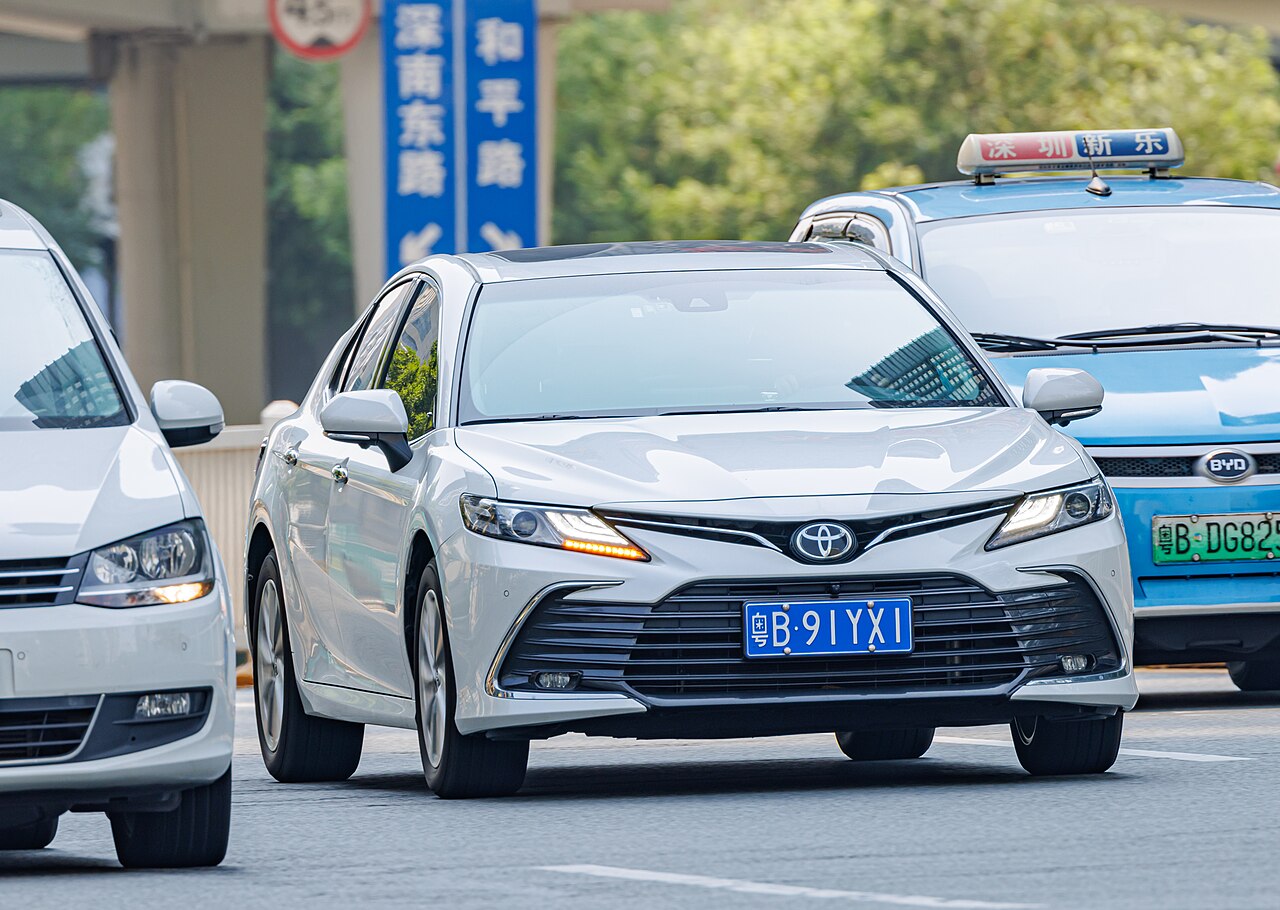
The modern used market really begins with the sixth-generation XV40 (2007–2011), the seventh-generation XV50 (2012–2017), and the eighth-generation XV70 (2018–2024), with the all-new hybrid-only XV80 arriving for 2025. Knowing which engine sits under the hood matters more than the badge on the trunk.
The base four-cylinder is where the story turns. Early XV40 cars used the 2.4-liter 2AZ-FE, an engine with a well-documented flaw we will get to. From 2010 onward Toyota switched to the 2.5-liter 2AR-FE, a far more durable unit that carried the reliable XV50 through 2017, usually paired with a robust six-speed automatic. The 3.5-liter 2GR-FE V6 offered across these years is one of the strongest engines Toyota has ever built — smooth, quick, and largely trouble-free. The XV70 introduced the Dynamic Force 2.5-liter and a new eight-speed automatic that needed some sorting in its first years.
The problems every owner should know
The Camry's recall history is dominated by a few systems. Equipment leads the federal tally with 25 campaigns, including a 2016 recall (16V420000) over an incorrect load label that could lead an owner to overload the car. Exterior lighting accounts for 18 campaigns, air bags for 15, and seats for 14 — a profile that looks worse in isolation than it is in context for a car sold in such enormous volume over four decades.
Within air bags, two campaigns stand out. A recall covering 2022 cars (23V865000) addressed an occupant-classification sensor fault that could prevent an air bag from deploying in a crash, and an electrical-system recall on 2012 cars (13V442000) addressed a short circuit that could disable the air bags or cause an inadvertent deployment. On the seats side, a recall covering 2007 cars (16V396000) flagged a front seat-heater element whose copper strands could short and create a fire risk. Older cars are not exempt either: a recall covering 1998 cars (09E025000) addressed headlights with decreased lighting that could contribute to a crash. Toyota's broader 2009–2010 vehicle-speed-control saga — the floor-mat entrapment and sticky-accelerator-pedal episodes that swept the lineup — sits within the eight vehicle-speed-control campaigns on the Camry's record.
Two non-recall issues are the ones used buyers feel most. The first is excessive oil consumption on the 2.4-liter 2AZ-FE engine in roughly 2007–2009 Camrys. Defective piston oil-control rings could carbonize and lead the engine to burn around a quart every 1,000 to 1,500 miles; Toyota acknowledged it in a 2011 technical service bulletin and revised the pistons and rings, and a 2014 class-action lawsuit followed. Any car from those years should be checked for oil level and consumption history before purchase. The second is the sticky, melting dashboard that afflicted 2007–2011 Camry and Camry Hybrid cars in hot, humid climates, turning the dash gooey and creating windshield glare; Toyota ran a warranty-extension repair program that ended in 2017.
Transmissions deserve a final word. The 2012–2014 four-cylinder cars could exhibit a torque-converter shudder — a vibration felt under light acceleration between roughly 25 and 50 mph. And the eight-speed UA80 automatic that debuted on the 2018 XV70 generated early complaints of harsh low-speed shifts and hesitation from a rolling stop. Toyota issued powertrain-control software updates that eased the problem for many owners, so on any 2018–2021 gas Camry, confirm that calibration was applied.
Which Camry should you buy?
If you want the cleanest combination of reliability and value, the 2015–2017 XV50 is the sweet spot. By then the 2AR-FE four-cylinder and the 2GR-FE V6 were mature, the six-speed automatic was proven, and these cars had earned a strong reliability and resale reputation. The 2017, in particular, had ironed out the earlier shudder complaints and is widely regarded as the best of its generation.
Approach the 2007–2009 cars with eyes open: budget for an oil-consumption check and inspect the dashboard. The very early XV70s (2018–2019) are fine buys provided the transmission software update is documented; by 2020–2024 the eight-speed had settled into a smooth, dependable unit. The new XV80, sold only as a hybrid from 2025, is too fresh to judge on the federal record but inherits a powertrain Toyota has refined over five generations of hybrids.
Buy the Camry for what it is — a 200,000-mile appliance — and simply verify the handful of years where Toyota's engineering blinked.
Do the job the way Toyota's engineers intended
A factory service manual for your exact model year lays out the OEM procedures, torque figures and wiring diagrams behind every repair in this guide — from a 2AZ-FE piston-and-ring job to tracing an air-bag circuit fault. It is the difference between guessing and knowing.
Find your Camry manual →